

Productivity Super-Deduction Canada is worth paying attention to if you’re planning equipment, technology, or facility upgrades in 2026. Not because it’s free money, but because it can change how quickly you deduct certain capital costs for income tax purposes.
If you’re a business owner or a manager signing off on capital spending, this is really about planning. You want to know what might be eligible, what paperwork you will need, and how to avoid the classic bookkeeping mess where the purchase was fine but the records make the claim painful later.
In this guide, we’ll cover what the measure is and why it matters for decision makers, what purchases to track before you buy, the bookkeeping and documentation that protects your claim, timing strategy that considers cash flow and financing, and a practical talk-to-us-before-you-buy workflow you can actually use.
What the Productivity Super-Deduction Canada is and why it matters
Budget 2025 introduced the Productivity Super-Deduction as a package of enhanced tax incentives intended to encourage new capital investment. The headline idea is simple: for certain investments, businesses may be able to write off a larger share sooner, which can reduce taxable income earlier than the standard capital cost allowance approach.
If you want the government’s wording, start with Budget 2025 Chapter 1 and then review the details in the Budget 2025 Tax Measures supplementary information.
Budget 2025 describes the package as including a reinstated Accelerated Investment Incentive (enhanced first-year write-off for many capital assets) and expanded immediate expensing for specific categories. It also includes temporary immediate expensing rules for eligible manufacturing or processing buildings, subject to conditions and a phase-out later.
Here’s the part I say to clients because it prevents bad decisions: this is about how fast you recover cost through deductions, not whether the purchase is affordable. A faster deduction can improve after-tax results in the year you invest if you have taxable income, but it does not pay the vendor invoice. Your bank account still feels the full cost.
If you’ve ever approved a $120,000 equipment purchase because it’s deductible, and then spent the next two months playing whack-a-mole with cash flow, you already know why I’m emphasizing that.
What purchases you should track before you buy in 2026
When people hear Productivity Super-Deduction Canada, they often ask for a neat list of what qualifies. In practice, eligibility depends on detailed rules, your use case, and how the asset is classified. A better approach is to identify the purchase categories that commonly come up, then build a tracking habit that makes review easy.
Here are the practical buckets Budget 2025 points to, translated into normal business language.
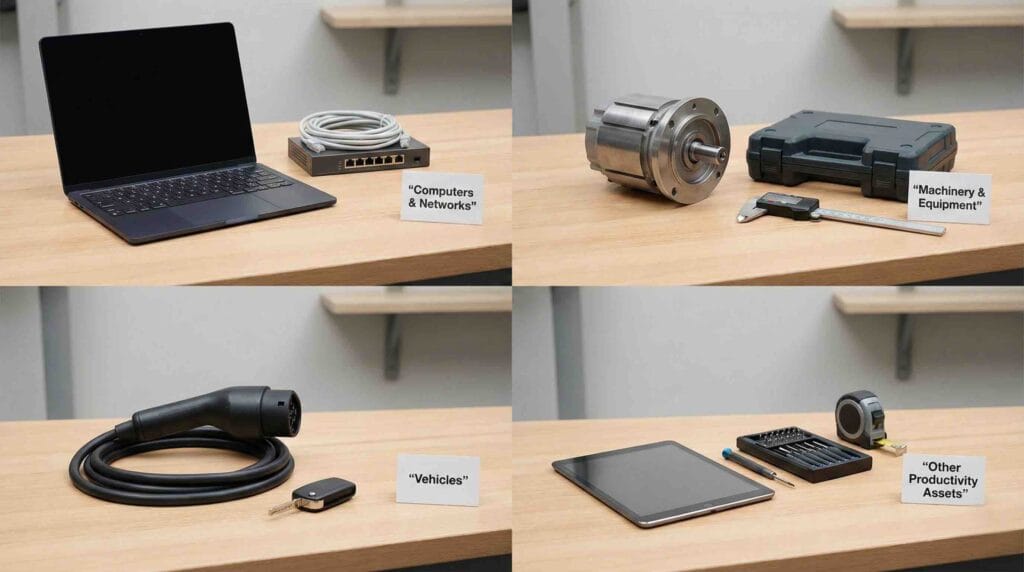
Manufacturing and processing machinery and equipment
If you run a manufacturing or processing operation, machinery and equipment is often the biggest spend and the biggest potential deduction timing impact.
Real examples I see in Canadian SMBs include CNC equipment, packaging lines, compressors, fabrication tools, commercial processing equipment, automation add-ons, and material handling equipment.
The accounting tip is simple: these purchases rarely arrive cleanly as one invoice. You’ll have deposits, shipping, duties, installation, electrical work, and sometimes training. If you want clean CCA treatment, you need a process to gather the full landed cost and document what was capitalized.
Computers, data networks, and patents (productivity assets)
Budget 2025 explicitly calls out productivity assets such as computers, data network infrastructure, and patents as part of the immediate expensing expansion. That’s relevant for a lot of mid-sized businesses that are upgrading systems, adding locations, or standardizing hardware.
In the real world, this might include servers and network refreshes, laptops and workstations for growth, routers, switches, cabling, and related infrastructure, and certain IP-related costs where applicable.
This is also where bookkeeping often goes sideways. Tech purchases get coded as repairs and maintenance one month, office supplies the next, and software subscriptions after that, even when the underlying spend is clearly a capital asset. If you want to benefit from Productivity Super-Deduction Canada, consistency matters.
Clean energy equipment and zero-emission vehicles
Budget 2025 also discusses immediate expensing for certain clean energy generation or energy conservation equipment and zero-emission vehicles. For many businesses, the biggest practical item here is vehicle planning.
If you’re replacing a fleet vehicle, adding a service van, or moving to a zero-emission option, you want to track the VIN, purchase agreement, delivery date, and in-use date cleanly. You also want to be careful with mixed use and who the vehicle is assigned to.
SR&ED capital expenditures (where applicable)
Budget 2025 points to immediate expensing of capital expenditures for SR&ED in certain contexts. If SR&ED applies to you, the documentation standards are usually higher and the review is more detailed.
The practical takeaway is not to treat SR&ED capital like normal equipment purchases. Plan the documentation up front so you are not trying to rebuild the story at year-end.
Manufacturing or processing buildings (for larger operators)
The building side is where the conditions matter most. Budget 2025’s supplementary tax measures discuss temporary immediate expensing for eligible manufacturing or processing buildings, including a 90 percent floor space use requirement and timing rules, plus phase-out later. If you’re evaluating a building project, it’s worth reading the relevant sections in the Budget 2025 Tax Measures supplementary information early.
If you’re in this category, treat it as a project, not a purchase. You will want your accountant and your bookkeeping team involved early so the costs are tracked properly by component and by timing.
Bookkeeping requirements: the difference between claimable and messy
Most missed opportunities I see are not because a business didn’t qualify. They happen because the records were incomplete, the asset was coded incorrectly, or nobody captured the available-for-use date properly.
This is where Productivity Super-Deduction Canada becomes a bookkeeping discipline issue, not just a tax note.
Build a clean fixed asset register that someone actually maintains
A fixed asset register does not need to be fancy. It needs to be reliable.
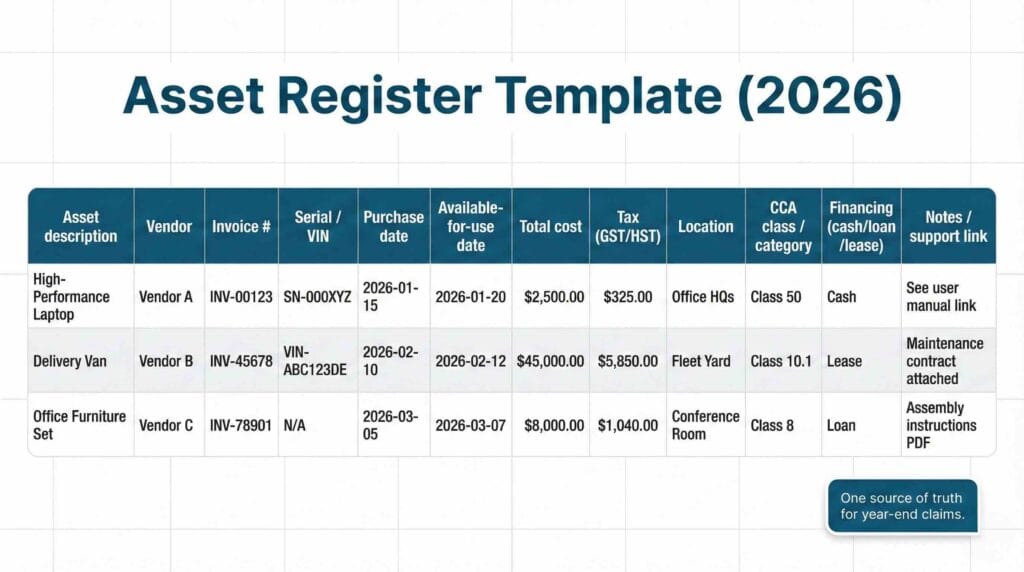
At minimum, you want one place that captures asset description, vendor, invoice number, serial number or VIN when applicable, purchase date, total cost, taxes, financing details, location, and the CCA class or tracking category your accountant uses.
If you’re using cloud systems like QuickBooks Online, you also want consistent account mapping so assets don’t get scattered across random expense accounts.
If you don’t have a strong month-end routine right now, it’s worth tightening that up first, because fixed asset tracking lives or dies on month-end discipline. If you need a framework, start with your own Month-End Close Checklist for Canadian Businesses (2026).
Productivity Super-Deduction Canada and the available-for-use file
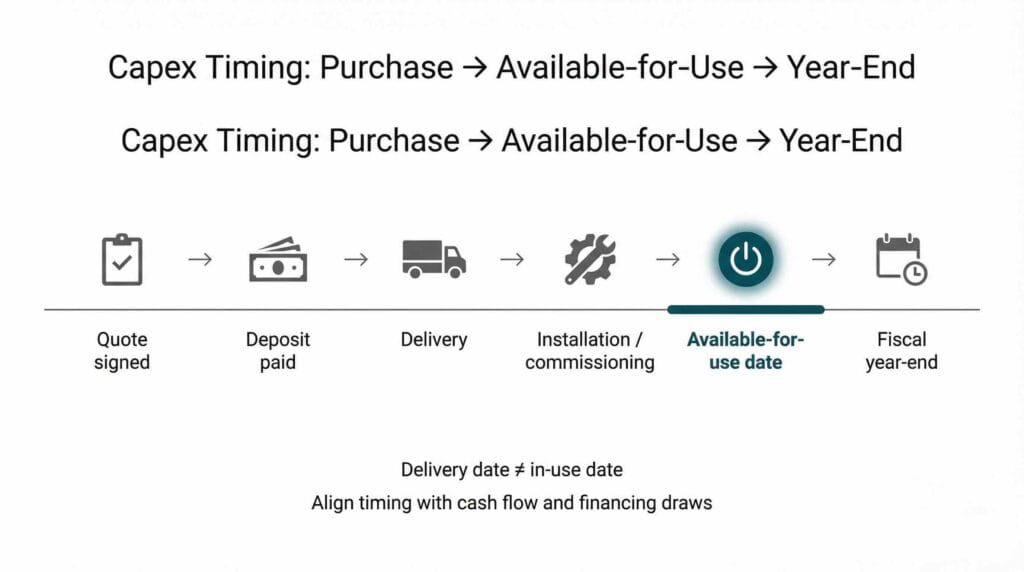
This is the detail that gets missed constantly: deduction timing can depend on when an asset is available for use.
For each major asset, keep a simple available-for-use file with delivery confirmation, installation or commissioning sign-off, go-live notes if it’s a system change, and photos of the serial number or VIN for equipment and vehicles.
Why does this matter? Because if you ever have to support a claim later, you want a clean story that matches your accounting entries and your operational reality.
Keep invoices and supporting documents in one trail
The CRA’s general expectation is that businesses keep adequate books and records to support amounts reported on tax returns. As a practical best practice, most businesses retain records for at least six years from the end of the last tax year to which they relate, but your circumstances can vary. Start with the CRA’s own guidance on keeping records for your business and apply it consistently.
Here’s the bookkeeping test I use: if someone new joined your team tomorrow, could they go from invoice to proof of payment to asset register entry to the exact posting in the ledger without asking you ten questions?
If the answer is no, you don’t have a tax problem yet. You have a process problem that will eventually become a tax problem.
Timing strategy: align tax planning with cash flow and financing reality
A faster write-off is helpful, but it can also tempt businesses into making timing decisions for the wrong reason. The right order is usually operations first, cash second, tax third.
This matters because Productivity Super-Deduction Canada can reduce taxable income sooner, but it does not change your payment schedule, your interest costs, or your covenant reporting.
Start with operational ROI, not the deduction
Before you buy, get specific about what the asset changes: throughput, labour hours, scrap rate, downtime, delivery speed, customer capacity, or quality control.
If you can’t explain the operational payoff in one paragraph, the tax angle will not save the decision.
A good internal exercise is to connect the purchase to management reporting. If you are already doing job costing, margin tracking, or project reporting, you’ll have a cleaner way to measure whether the asset actually performed. If you’re in trades or project work, your own Job Costing in QuickBooks: A 2026 Guide for BC Trades is a solid reference point.
Then model the cash flow, including the ugly extras
This is where a lot of budgets fall apart. People plan for the sticker price and forget deposits, staged payments, shipping, duties, installation, electrical or site prep, training time, downtime, and extended warranties.
If you’re financing the purchase, map the draw date and repayment start date against your seasonal cash flow. If you operate in tourism, hospitality, or another seasonal business, this is especially important. For a deeper look at the cash side, see our Cash Flow Management for Seasonal Tourism Businesses in Canada: A Practical Guide.
Then look at fiscal year-end timing and reporting needs
Once you know the operational case and the cash case, then you can consider timing: your fiscal year-end, when the asset will actually be available for use, how the purchase affects taxable income in that year, and whether you are likely to be profitable.
If you want a CRA baseline on how CCA works in general, start with the CRA’s Capital Cost Allowance overview.
Common pitfalls that cost time (and sometimes money)
Most of these are preventable, and they are the exact issues that show up when a business tries to claim Productivity Super-Deduction Canada without tightening up the back office.
First, assets get coded as expenses because someone was rushing through the bills list. That leads to messy corrections later and inconsistent reporting now.
Second, costs get split across months with no project folder. By the time year-end arrives, you can’t tell what belongs to the asset and what was operational.
Third, the in-use date is assumed instead of documented. The delivery date is not always the in-use date, especially with equipment installation or network upgrades.
Fourth, leases and loans get mixed up in the bookkeeping. The treatment can be different depending on the arrangement, and you want the agreement filed and easy to find.
Finally, businesses rely on a tax deduction to justify a purchase they cannot comfortably fund. That is how a smart investment turns into a stressful year-end.
A practical workflow: talk to your bookkeeping team before you buy
This is the part that makes Productivity Super-Deduction Canada usable instead of theoretical.
Before the purchase, do a short pre-purchase review that covers how the purchase will be coded, what details must be captured in the asset register, who will collect the available-for-use evidence, how deposits and staged invoices will be tracked, and how financing documents will be stored and reconciled.
If you’re running QuickBooks Online and you have multiple systems feeding data in, it’s worth checking that integrations won’t hide the details you need. Sometimes the invoice lands as a generic summary entry that is useless for fixed asset tracking. If that’s your setup, review our guide on POS integration with QuickBooks: A Clean Setup Guide for 2026 and tighten the workflow before the purchase hits.
Productivity Super-Deduction Canada checklist for clean records
Keep this short and practical. For each major purchase tied to Productivity Super-Deduction Canada, confirm you have a signed quote or purchase agreement, a vendor invoice with a clear asset description, proof of payment or financing draw evidence, serial number or VIN if applicable, a delivery record, installation or commissioning sign-off, and an asset register entry that matches the ledger posting.
If you do those consistently, year-end becomes straightforward instead of stressful.
Wrapping it up: make the deduction easy to support
The businesses that get the most value out of Productivity Super-Deduction Canada are not the ones chasing tax tricks. They are the ones that plan capital spending like a process: clear operational justification, realistic cash flow modelling, and bookkeeping that captures the story as it happens.
If you’re buying in 2026, the best move is to set up your tracking before the first deposit goes out. Once invoices start landing, it’s surprisingly easy for details to get lost.
At Valley Business Centre, we’ve supported businesses across Metro Vancouver, Whistler, Squamish, and the Sea to Sky Corridor for more than 30 years with bookkeeping, payroll, tax preparation, and cloud accounting systems.
If you’re a BC business planning equipment, tech, or vehicle purchases in Vancouver, Surrey, Burnaby, Richmond, Coquitlam, or North Vancouver and you want to capture Productivity Super-Deduction Canada opportunities without last minute cleanup, reach out. We can help you tighten up tracking, reconcile deposits and payouts, and keep documentation organized so year end feels straightforward instead of stressful.
