

Month-end close checklist is the simplest way to turn a busy month of invoices, payroll runs, card deposits, and supplier bills into financial statements you can actually trust. If you’ve ever looked at a “profitable” month on paper while your bank account felt tight, you already know why this matters.
In practical terms, the close is where you answer questions like: Did we make money, or did we just bill a lot? Are taxes and payroll liabilities building up correctly? Did margins shift because of pricing, costs, staffing, or just messy coding?
For Canadian small and mid-sized businesses, a clean month-end close checklist is not about perfection. It’s about consistency. The goal is decision-ready numbers, on a predictable timeline, with fewer surprises when GST/HST is due or your year-end accountant asks for support.
What “month-end close” means in plain English
A month-end close is the routine of finishing the month’s bookkeeping so your reports reflect reality, not guesswork.
Think of it as “locking down” the month.
You capture what happened, reconcile what moved through cash, apply the right timing (cutoff and accruals), and then review the results before anyone makes decisions off the numbers.
A strong month-end close checklist solves a common owner problem: “Our bank balance is up, but we still feel broke.” That feeling usually comes from one of these gaps:
– Revenue recorded, but cash not collected (AR is climbing).
– Bills and payroll liabilities building up behind the scenes.
– Card processors holding funds, or fees not accounted for.
– Inventory and COGS out of sync, creating “paper profit.”
If you’re running a growing business, the close is also a control. It’s how you catch errors while they’re still small and fixable.
A simple close timeline for Day 1 to Day 5
You do not need a 15-day close to get reliable reporting. Most owner-managed and mid-sized teams can aim for Day 5, as long as the workflow is repeatable.
Here’s a realistic cadence that matches how a controller would structure it:
– Day 1 to 2: capture transactions and reconcile cash.
– Day 3 to 4: accruals, payroll and GST/HST tie-outs, and variance checks.
– Day 5: finalize reports and do a short management review pack.
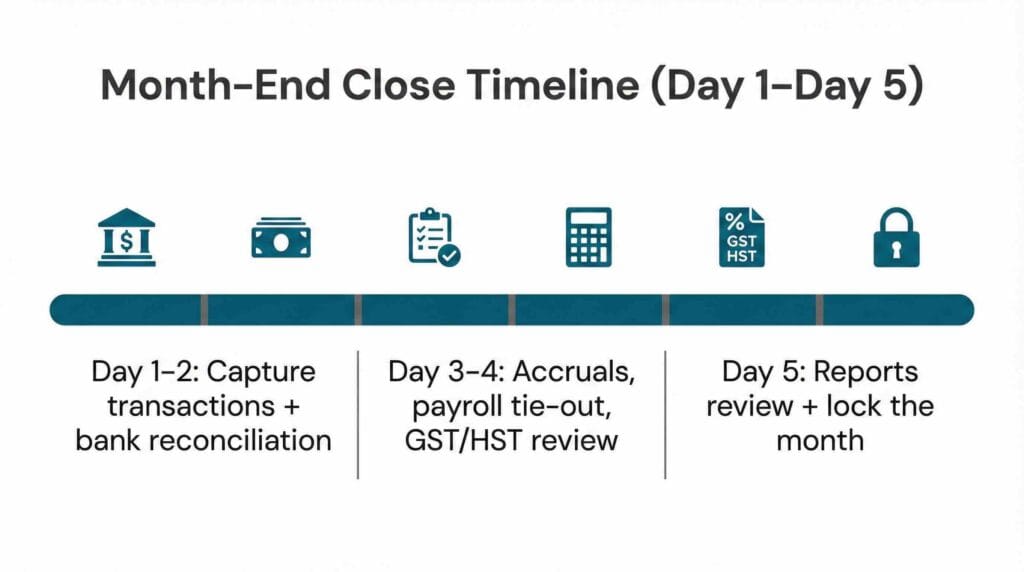
The reason I like this timeline is that it forces focus. You get cash and clearing accounts correct first, then you validate revenue and expenses, then you sanity check the story the numbers are telling.
How to use this month-end close checklist in your bookkeeping system
Before we get into the steps, set yourself up for success.
First, choose one “source of truth” for sales. If you use a POS, ecommerce platform, or booking system, make sure it’s properly connected to your accounting file and that deposits match what the system says you earned. If you’re working through QuickBooks, a clean integration matters more than most people expect. If you want a practical walk-through, see this guide on POS integration with QuickBooks.
Second, decide who owns each part of the close. Even in a small business, it helps to define: who reconciles, who reviews, and who approves.
Third, keep your support in one place. A month-end close checklist works best when it produces a simple workpaper trail: bank rec PDFs, GST/HST detail, payroll liability reports, and a short variance note.
The 10-step month-end close checklist (controller style)
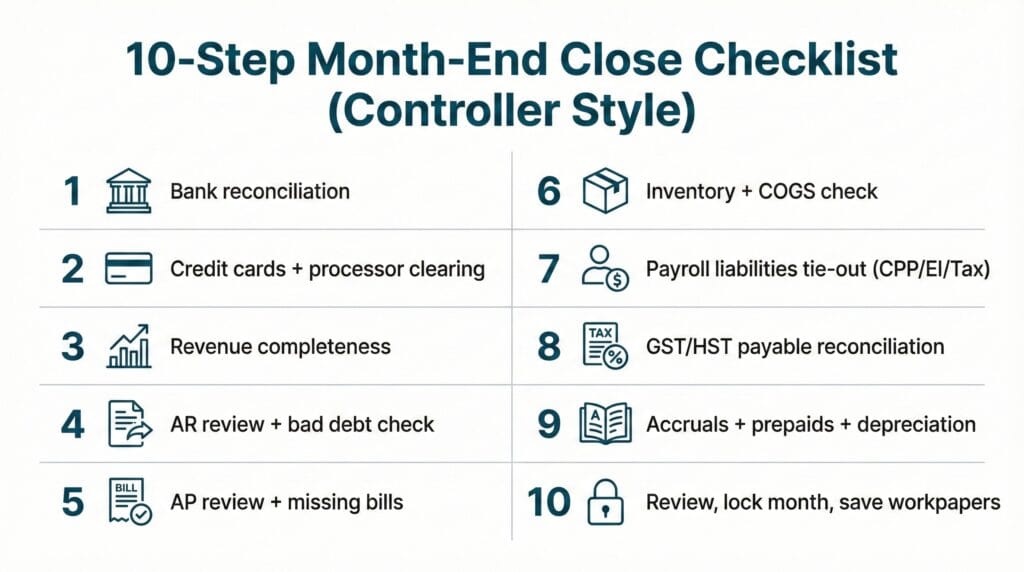
This is the core month-end close checklist I recommend for Canadian businesses in 2026. If you do nothing else, do these ten steps in order. The order matters because early steps reduce rework later.
1) Reconcile bank accounts and investigate undeposited funds
Start with the bank. Always.
Match the statement to your books and clear any old items that should not be sitting there. Pay special attention to undeposited funds or deposit clearing accounts. When deposits sit uncleared, your sales and cash reporting can drift apart fast.
If you find that bank reconciliations take hours every month, that’s usually a process issue upstream: missing documentation, inconsistent coding, or unclear approval steps. If you want a deeper read on the habit itself, see Do I Really Need to Reconcile My Bank Account – Every Month?
2) Reconcile credit cards and payment processor clearing
Next, tie out credit card statements and any payment processors (Stripe, Square, Moneris, PayPal, etc.).
A lot of “mystery differences” live here because processors deposit net amounts. Your books need to reflect gross sales, processing fees, chargebacks, and the net deposit correctly. If you use a clearing account, it should trend back toward zero after reconciliation.
This is one of the most valuable parts of a month-end close checklist because it protects both revenue accuracy and expense classification.
3) Confirm sales and revenue completeness for the month
Now confirm you actually recorded everything you earned.
For invoice-based businesses, check that all invoices issued for the month are posted and that any credit notes are recorded properly.
For POS or ecommerce, validate that daily or weekly summaries match what hit the books. If you use QuickBooks, a properly configured POS integration reduces manual errors and keeps deposit matching clean. (If this is a pain point, the POS integration with QuickBooks setup guide is worth bookmarking.)
4) Review Accounts Receivable (AR) and do a realistic bad debt check
Run an AR aging report and look at it like an owner, not like a bookkeeper.
What is current? What is 30, 60, 90+ days? Are there a few repeat offenders?
If older balances are unlikely to be collected, consider a policy-based bad debt allowance. The point is not to be pessimistic. The point is to stop overstating profit by pretending all receivables are as good as cash.
A month-end close checklist is doing its job when AR surprises get smaller each month.
5) Review Accounts Payable (AP) and catch missing bills
This step is about completeness.
Make sure all supplier bills received for the month are entered, even if you haven’t paid them yet. Then scan for the usual missing items:
- rent
- software subscriptions
- utilities
- contractor invoices that arrive late
If you only record expenses when you pay them, your profit can look artificially high in a month where you delayed payments. That’s why this step pairs closely with cutoff rules later.
6) Inventory and COGS check (if you sell products)
If you sell products, do not skip this.
You do not need a full physical count every month, but you do need enough checks to catch drift: negative inventory, duplicate items, purchases coded incorrectly, and uncaptured freight or duty.
If you’re using an inventory app or integration, confirm it’s still syncing properly and that your cost flow assumptions are consistent. If inventory is a recurring pain point, this overview of Best Inventory Integrations for QuickBooks Online in 2026 can help you choose a setup that reduces manual fixes at month-end.
A solid month-end close checklist keeps your gross margin believable. Without this step, margins can swing for reasons that have nothing to do with operations.
7) Payroll liabilities and remittance tie-out
This is where many Canadian businesses get blindsided.
Tie your payroll payable accounts (CPP, EI, income tax, and any provincial items that apply) back to payroll reports. Then confirm remittances were made and recorded correctly.
CRA remittance due dates vary by remitter type, so always confirm your schedule and do not assume everyone remits the same way. The CRA’s reference page on how and when to remit source deductions is the best place to check.
If you want to reduce audit stress, this is also where clean documentation matters. Our CRA Payroll Audit Red Flags article pairs well here when you’re tightening processes.
8) GST/HST payable reconciliation and filing readiness
Treat GST/HST as a control account, not a year-end scramble.
Reconcile GST/HST collected and input tax credits to the ledger and investigate odd swings. A common issue is tax coded incorrectly on purchases, especially mixed-use expenses or items with special tax treatment.
For deadlines, CRA’s page on GST/HST reporting requirements and deadlines is the authority.
For broader guidance that’s easy to share with your team, the CRA GST/HST guide for registrants (RC4022) is also useful.
A month-end close checklist that includes GST/HST reduces that sinking feeling when filing time arrives.
9) Post month-end adjustments: prepaids, accruals, depreciation, recurring entries
This is where the numbers start to reflect the month’s true activity.
Common entries include prepaids (annual insurance, software), accruals (wages payable, vacation pay, utilities incurred but not billed), and depreciation/amortization.
If your team debates cash vs accrual every month, it helps to align on a consistent approach. If you want a refresher you can hand to a manager, see The Difference Between Accrual and Cash Accounting.
Recurring entries are fine to automate when they are stable, but anything tied to usage should be reviewed monthly. A month-end close checklist is not meant to be mindless. It’s meant to be repeatable with judgement.
10) Review, lock the month, and save workpapers
Finally, review the output and protect it.
Run your key reports, do a quick variance pass, then lock the period (or restrict changes) so last month doesn’t silently change when someone posts a late entry.
Save your workpapers where you can find them later. CRA record retention expectations matter here, and CRA’s guidance on keeping business records is clear.
This last step is the difference between “we closed the month” and “we think we closed the month.”
Cutoff rules that prevent fake profit
If you want cleaner margins and fewer surprises, tighten cutoff rules.
Revenue cutoff is about when you earned it. For many businesses, that’s when you delivered the product or performed the service, not necessarily the invoice date.
Expense cutoff is about when you received the goods or services, not when you paid.
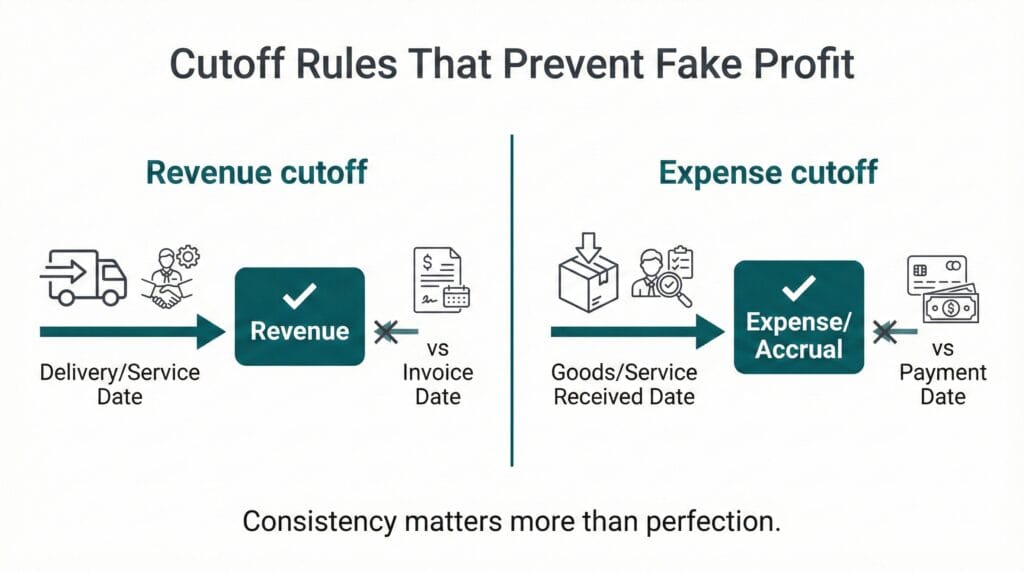
Where businesses get into trouble is inconsistency. They record revenue quickly but delay expenses until bills arrive, which inflates profit in the short term and causes the “why did profit collapse next month?” conversation later.
If you want a practical way to apply cutoff using your month-end close checklist, start with these usual accruals:
- Wages payable (especially if payroll spans month-end).
- Vacation pay accruals (if you track them).
- Utilities incurred but not billed yet.
- Interest on loans.
- Merchant fees tied to the month’s sales.
You do not need to over-engineer this. You need a policy you can follow every month.
How to catch errors early with variance checks
Variance checks are your early warning system. They do not replace reconciliations. They tell you where to look next.
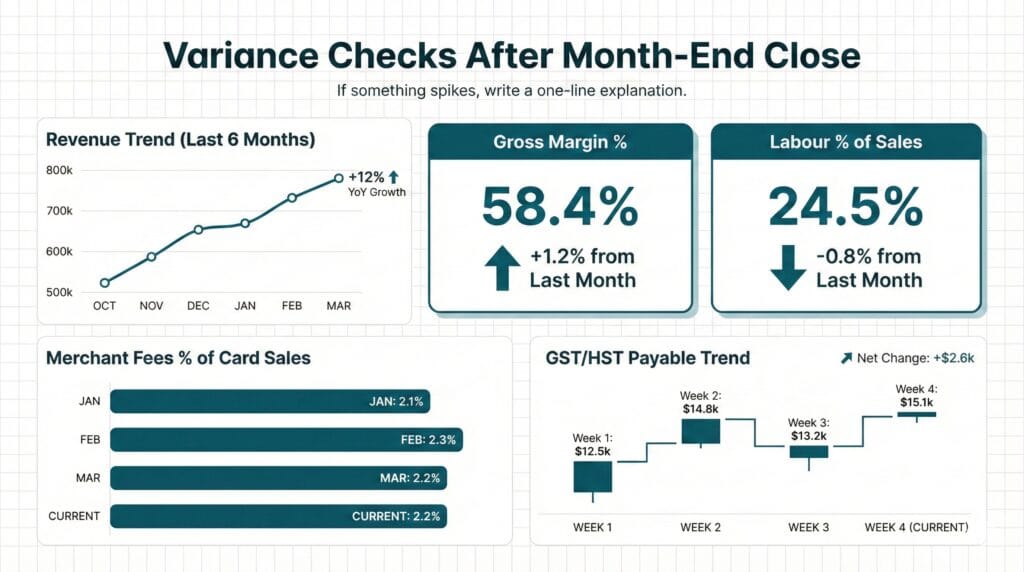
Here are the variance checks I typically run after the core month-end close checklist is done:
- Revenue trend versus last month and versus the same month last year.
- Gross margin percentage trend, especially by product line or service category.
- Labour percentage trend, and whether it matches staffing changes.
- Merchant fee percentage of card sales.
- GST/HST payable movement that should broadly track sales and taxable purchases.
- Balance sheet sanity checks like negative inventory, stale clearing accounts, or sudden jumps in AR or AP.
When something looks off, write one short note. It can be as simple as: “Margin down 4 points due to supplier cost increase on Line A.” Those notes become gold in month three when you’re trying to remember what happened in month one.
Deliverables owners and managers should review monthly
If you’re the owner or a decision maker, you do not need a 40-page package. You need a tight review set that helps you act.
At minimum, ask for these deliverables after the month-end close checklist is complete:
- A P&L for the month and year-to-date, with gross margin visible.
- A balance sheet snapshot focusing on cash, AR, AP, debt, and taxes payable.
- AR and AP aging to support collections and cash planning.
- A payroll and sales tax liability summary so you know what’s owed and when.
- A short KPI page that highlights the top five metrics and any exceptions.
If you do this monthly, you will spot issues while they’re still manageable. You’ll also get faster at making decisions because the numbers stop feeling like a moving target.
What usually slows down the close (and how to fix it)
If your close drifts into Day 10 or later, it’s rarely because the accountant “works too slowly.” It’s usually because inputs are late or inconsistent.
The most common bottlenecks I see:
- Receipts and invoices arrive in a scattered way, so coding happens in batches.
- Bank feeds contain uncategorized items that pile up.
- Sales systems do not match deposits, so someone is chasing differences.
- Payroll entries and remittances are not aligned with the GL.
- Nobody “owns” clearing accounts, so they drift month after month.
A month-end close checklist fixes this when it becomes part of the operating rhythm, not a once-a-month scramble. In many businesses, the real improvement is doing light cleanup weekly so the month-end work is mostly review, not detective work.
Tools and habits that make this repeatable in 2026
You do not need more apps for the sake of having more apps. You need fewer moving parts and clearer rules.
A few practical habits that support a smoother month-end close checklist:
- Set a weekly cadence for coding and approvals so month-end is not a cliff.
- Standardize chart of accounts mappings for sales and direct costs.
- Use consistent naming for vendors and customers so reports are clean.
- Keep a short list of recurring accruals and review it every month.
- Document one-page procedures for bank recs, GST/HST review, and payroll tie-outs.
If payroll is a pain point, it’s worth revisiting how deductions and newer rules are handled so your liability accounts stay clean. The CPP2 payroll deductions 2026 checklist is a practical reference for employers.
Two quick FAQs I hear from Canadian owners
Do we have to close in five days?
No. Five days is a good target, but consistency is more important than speed. A reliable Day 8 close beats a chaotic Day 4 close.
Do we need a month-end close checklist if we’re small?
Yes, especially if you’re small. When there’s less cushion, one missed remittance, one mis-coded tax item, or one drifted clearing account can create very real cash stress.
Conclusion
A month-end close checklist is not busywork. It’s one of the simplest ways to make your financials useful, month after month.
If you implement the steps above and keep the timeline realistic, you’ll see the payoffs quickly: cleaner margins, fewer surprises in GST/HST and payroll liabilities, and faster decisions because you trust the numbers.
Just as importantly, you’ll spend less time arguing with reports and more time using them.
At Valley Business Centre, we’ve supported businesses across Metro Vancouver, Whistler, Squamish, and the Sea to Sky Corridor for more than 30 years with bookkeeping, payroll, tax preparation, and cloud accounting systems.
If you’re a BC business owner or manager in Vancouver, Surrey, Burnaby, Richmond, Coquitlam, or North Vancouver and you want a cleaner month-end close without last minute stress, reach out. We can help you tighten up tracking, reconcile deposits and payouts, keep documentation organized, and keep payroll and bookkeeping aligned so year end feels straightforward instead of stressful.
