
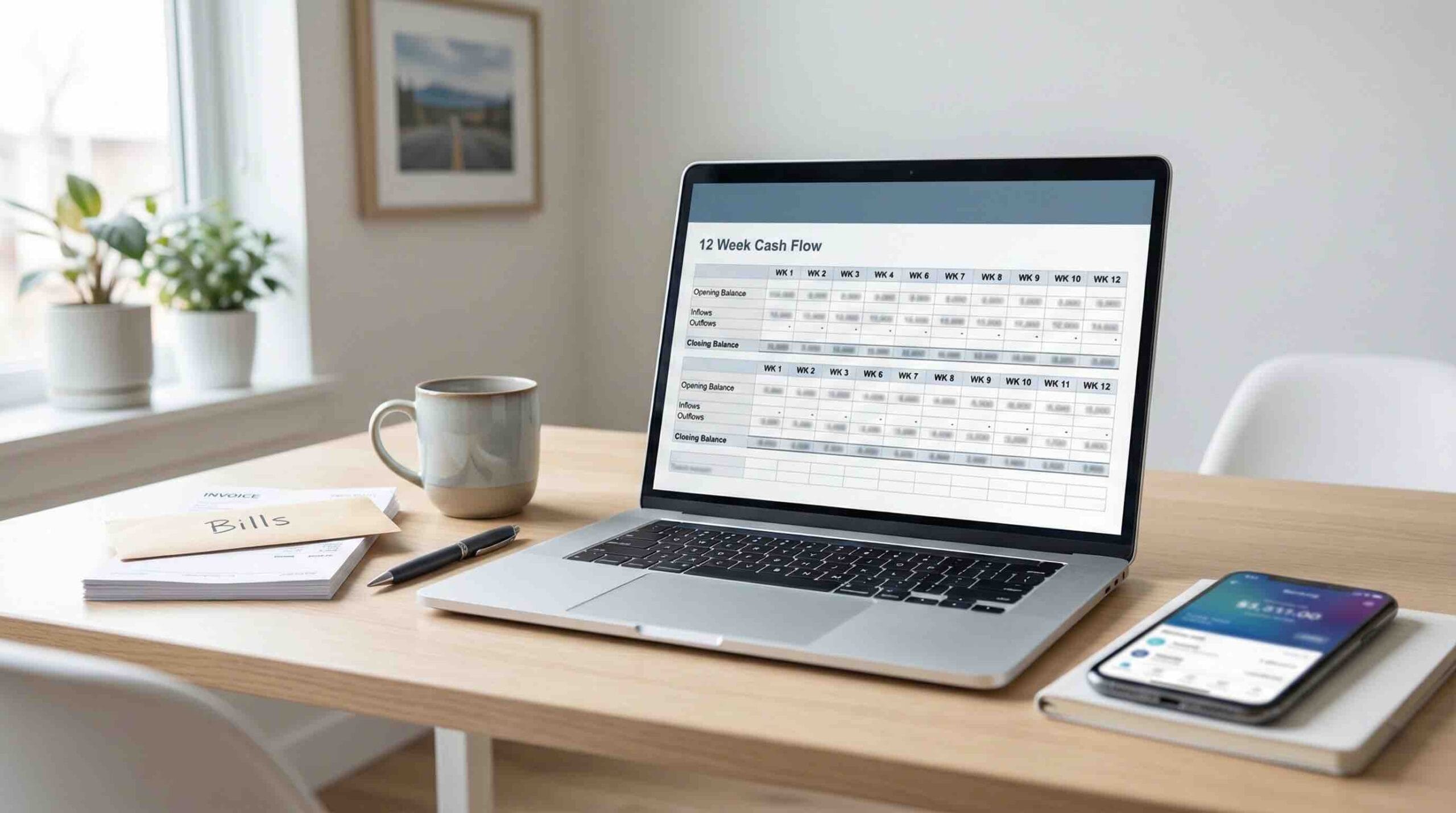
Cash flow forecast template is one of those phrases that sounds a bit finance-y until you’ve had a week where three things hit at once: payroll, a GST/HST remittance, and a supplier payment you forgot was due. Then it becomes very real, very fast.
In my experience working with Canadian owner-managed businesses, most cash flow stress is not caused by a bad year. It’s caused by bad timing inside a decent year. A 12-week forecast fixes that because it’s short enough to keep accurate, and long enough to see trouble coming while you still have options.
This playbook shows you how to set up a simple 12-week forecast, how to keep it honest, and what red flags to watch so you can act early instead of reacting late.
Why 12-week forecasts beat annual budgets
Annual budgets have a place. They’re useful for setting direction: revenue targets, hiring, marketing spend, and big-picture priorities.
But budgets are not great at answering the questions you actually need answered on a Tuesday afternoon, like whether you’ll have enough cash for payroll next week, whether an inventory buy will squeeze you in week six, or whether you can afford a new hire if collections run a little slower than usual.
A 12-week forecast is practical because it forces you into the world of timing. In Canada, timing matters because cash outflows often come in spikes: payroll cycles, payroll source deductions, GST/HST, rent, and debt payments. Those are not maybe expenses. They are real, scheduled commitments.
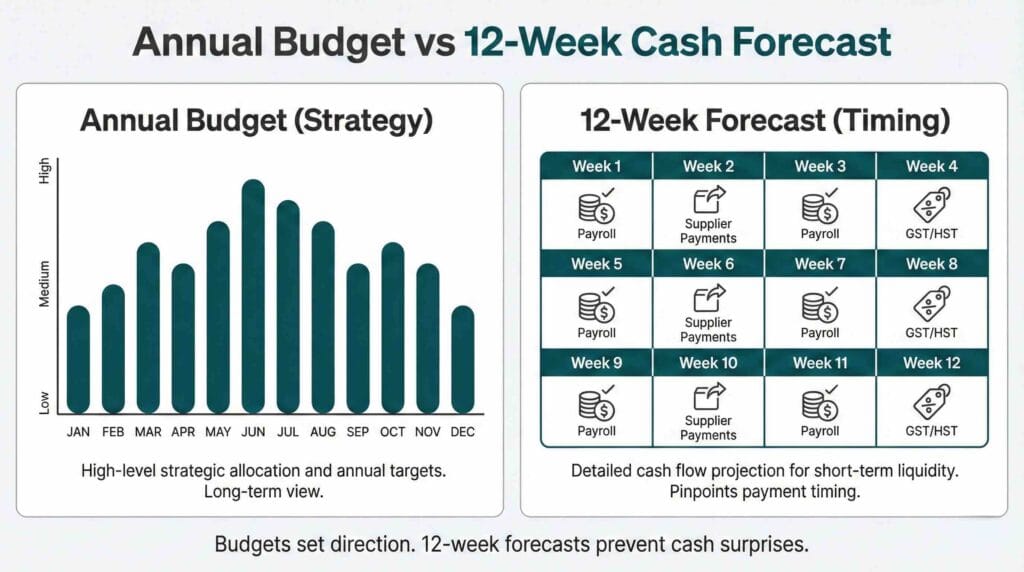
Here’s the other reason this works so well: you can actually maintain it. A 12-month forecast often becomes a document that ages poorly. A 12-week model, updated weekly, stays connected to reality.
If you already do a monthly close, you’ll find the 12-week rhythm pairs nicely with it. If your month-end process needs tightening, you’ll get more value from your forecast once your reconciliations are consistent.
Building your cash flow forecast template for a 12-week view
You do not need fancy software to start. You need a clean structure, a weekly cadence, and the discipline to keep assumptions realistic.
A good cash flow forecast template has three core sections: opening balance, inflows, and outflows. Then you layer scenarios on top.
Start simple. You can always add detail later.
Step 1: Start with the bank opening balance
Week 1 starts with the cleared bank balance you can see today. Not the balance after deposits should come in. Not the balance if you ignore outstanding cheques. Use what’s real.
If you run multiple bank accounts, pick one operating account for decision-making, then add a line for transfers if needed. The point is visibility, not perfection.
Step 2: Map weekly inflows
For most Canadian SMBs, inflows are driven by customer receipts, not invoices issued. That distinction matters. If your terms are net 30 but your average customer pays in 47 days, your forecast should respect that reality.
Common weekly inflows include customer receipts from accounts receivable collections, POS or e-commerce deposits, owner injections or shareholder loans if you truly plan to do them, confirmed financing draws, and other income such as rebates or refunds.
This is where a cash flow forecast template earns its keep. It forces you to separate sales from cash collected, and that’s often the first big mindset shift.
Step 3: Map weekly outflows
Outflows should be grouped in categories you can make decisions on. If you make the list too detailed, you’ll stop updating it.
Most businesses will include payroll, payroll source deductions, rent and lease payments, suppliers and subcontractors, loan or lease payments, sales tax remittances, and recurring operating costs such as insurance, utilities, and software. Then add a line for one-time costs like equipment, repairs, or professional fees.
If some of these are monthly, that’s fine. Put them on the week they leave the bank. The weekly view is about the date money moves, not the period it relates to.
For GST/HST timing, use the CRA GST/HST payments guidance and drop the payment into the correct week based on your filing cycle. For source deductions, keep the due dates visible using the CRA remitting payroll source deductions page as your reference.
Step 4: Add scenarios
Scenarios are not about predicting the future perfectly. They’re about seeing your range of outcomes so you can choose actions early.
A practical approach is to maintain three versions: base case, conservative case, and upside case. In the conservative case, assume collections slow down, sales dip, or one cost comes in higher. In the upside case, assume collections tighten up, sales lift, or you delay a discretionary spend.
Even a simple three-scenario setup makes your cash flow forecast template feel like a decision tool instead of a spreadsheet you dread opening.
How bookkeepers keep forecasts accurate week after week
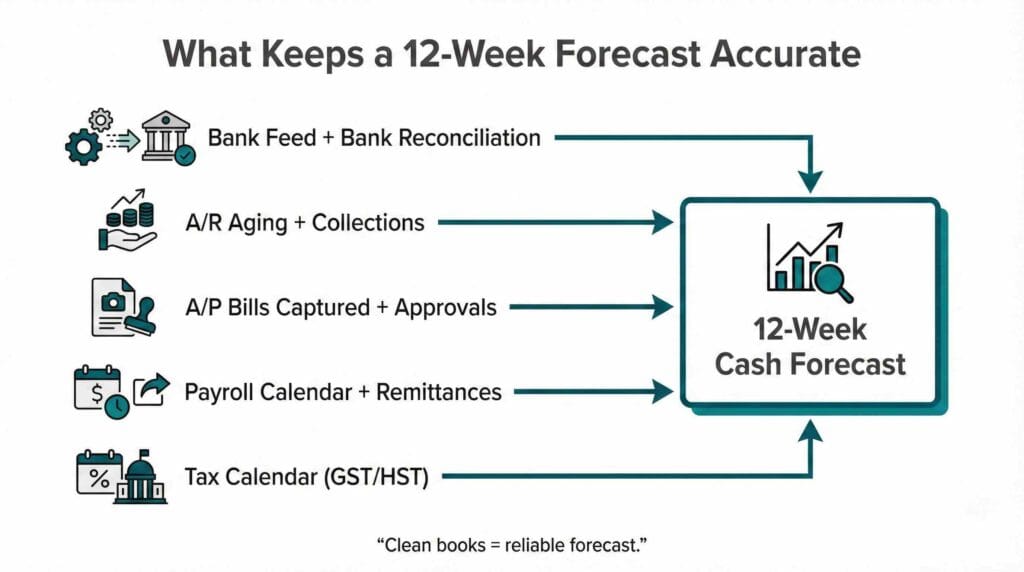
A forecast is only as good as the inputs. And the inputs come from behaviour: how you invoice, how you collect, how you approve bills, and how clean your books are.
This is the part many businesses underestimate. They build the sheet, but they don’t build the habits.
AR discipline: cash comes from collections, not invoicing
If you want a forecast you can trust, you need a predictable collections rhythm. That means invoicing promptly, setting deposit policies for larger jobs, reviewing your A/R aging weekly, and following up consistently on the biggest invoices first.
If collections are a pain point, you’ll get quick wins by tightening follow-up and setting clearer payment expectations. If you want a practical system for that, see improving accounts receivable collections.
When you run your cash flow forecast template, use realistic receipt timing based on your actual history, not your stated terms. Owners often tell me they’re net 30, then we check the data and the average is closer to net 45 or net 60. Your bank account lives in the real world.
AP discipline: bills must be captured early, not discovered late
Outflows become surprises when bills sit in inboxes, trucks, job folders, or personal credit cards without a process. A good workflow captures bills quickly, routes approvals on a consistent schedule, and runs payment batches on set days.
When cash tightens, you still need to treat vendors professionally. Sometimes you defer a payment, but you communicate, confirm revised terms, and protect your key suppliers. Vendor relationships are part of cash flow management, whether we like it or not.
A clean A/P process also prevents the common week 8 problem: you thought you were fine, then three delayed invoices arrive and the next two weeks are chaos.
Payroll and tax calendars: align the forecast to real due dates
In Canada, payroll rarely hurts because the wages are surprising. Payroll hurts because the full cash cost shows up in specific weeks, and owners forget the timing.
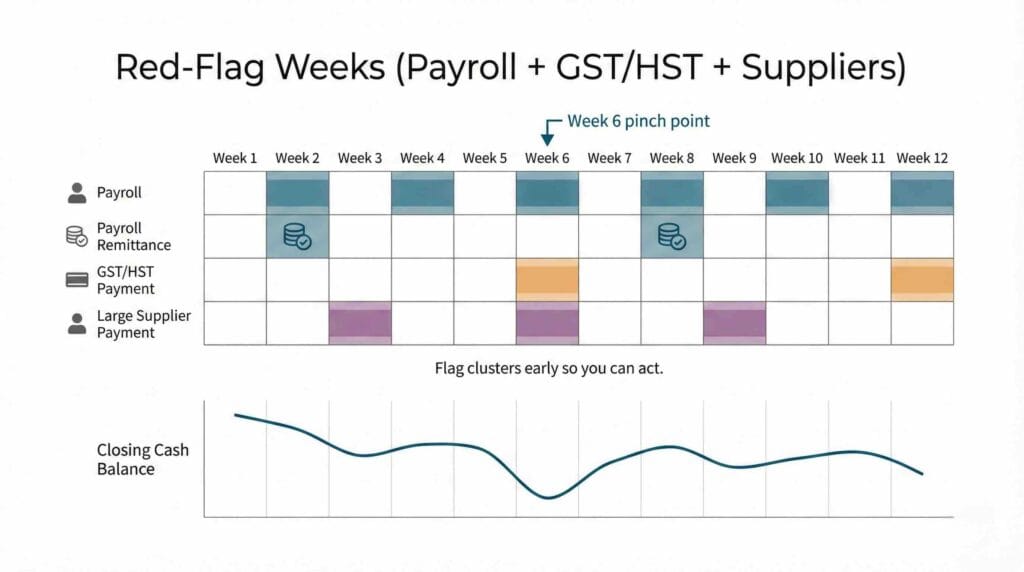
Make sure your cash flow forecast template reflects payroll frequency, stat holiday weeks, source deduction remittance due dates, GST/HST payment weeks, and corporate tax instalments when they apply.
If you want a clear view of compliance risk areas, your team will get value from reviewing CRA audit red flags alongside the forecast routine.
One source of truth: your books must support the forecast
Forecasts drift when bookkeeping is behind. If your bank reconciliation is two months late, or A/R is not reconciled, your forecast becomes guesswork.
If your forecast is fed by clean, current books, it becomes reliable quickly. That’s also why a consistent month-end process matters. A strong month-end routine reduces the garbage in, garbage out problem.
Red flags to watch
The best benefit of a rolling forecast is not that it predicts the future. It’s that it shines a light on patterns you can fix.
Here are the ones I see most often in Canadian SMBs.
Margin erosion: sales up, cash down
This one is sneaky. Revenue looks fine, but cash keeps slipping.
It often comes from discounting more than you realize, supplier costs rising faster than pricing, untracked overtime, or higher merchant fees as card volume increases.
Your cash flow forecast template will show the symptom first: your closing balance trends down even though sales appear steady. The response is to check gross margin by product, service line, or job type and adjust pricing, purchasing, or labour scheduling.
Payroll spikes: overtime, seasonality, and growth
Payroll spikes can happen even when headcount doesn’t change. Overtime, seasonal staffing, and benefit changes all show up in the bank account.
If you operate in tourism or seasonal cycles, you’ll recognize this immediately. A forecast lets you build the spike into the plan rather than being blindsided by it. For a deeper look at planning around seasonal swings, see cash flow management for seasonal tourism businesses.
A simple trick is to add a payroll buffer line. It’s not perfect, but it stops the model from being overly optimistic.
Tax remittance surprises: GST/HST and source deductions
GST/HST and payroll deductions are not negotiable payments. When they get missed, penalties and interest add insult to injury.
Your forecast should include tax payments as a standard line, not an afterthought. Some businesses also keep a separate tax set-aside bank account so remittance cash is not accidentally spent.
If you want CRA detail on payroll deductions and employer responsibilities, the CRA payroll overview is a good starting point.
Supplier terms tightening and inventory overbuying
If suppliers tighten payment terms, your cash conversion cycle changes overnight. You may still be profitable, but cash gets squeezed.
Inventory-heavy businesses see another version: buying too much, too early, because it feels safer to stock up. Your forecast makes the cost visible in the week it leaves the bank.
Sometimes the solution is staged purchasing. Sometimes it’s negotiating terms. Sometimes it’s using a line of credit strategically, but only if you understand the interest cost and repayment plan.
If you want a broader small business cash planning resource, BDC’s cash flow calculator and guide to managing cash flow are practical and owner-friendly.
A simple 12-week cash flow forecast template you can copy today
Let’s make this practical.
Set up your spreadsheet with columns for Week 1 through Week 12.
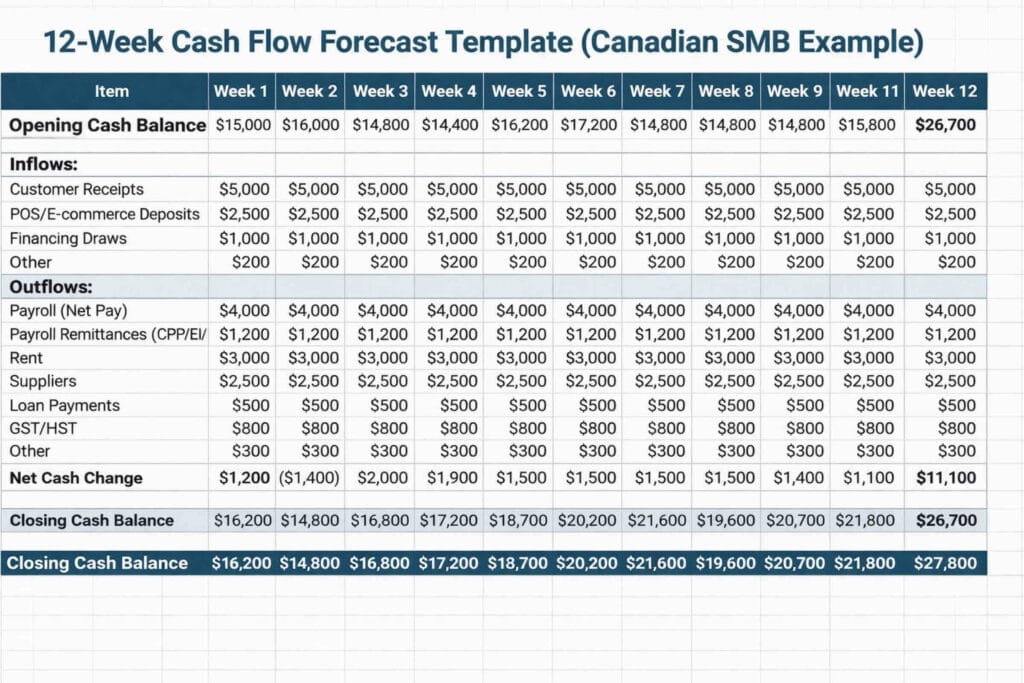
Rows will hold your categories. Keep it readable. At the top, you want opening cash balance, total inflows, total outflows, net cash change, and closing cash balance.
Below that, list inflows and outflows. If you have only one thing to get right, get the weekly closing cash balance right. That is what drives decisions.
How to update your cash flow forecast template in 20 minutes a week
Most businesses fail at forecasting because they treat it like a quarterly project. It should be a weekly habit.
If you need a simple routine, follow this sequence: 1) pick one day each week, 2) update the opening balance from the bank, 3) mark what cleared that week, 4) push the forecast forward by one week, 5) adjust the next three weeks based on new information.
That’s it. You’re not rewriting history. You’re keeping the next few weeks honest.
When you do this consistently, the cash flow forecast template becomes a living dashboard. It also makes owner conversations easier. Instead of saying you’re tight, you can say week 6 is the pinch point because GST/HST and payroll remittances land together, and if you accelerate collections from two customers, you’re fine.
That is a very different conversation.
What to include if you want a slightly smarter model
Once the basics work, you can add small upgrades. You might split A/R collections into top customers and everyone else, add a line for merchant fee timing, separate capital purchases from operating costs, or build scenarios using simple percentage assumptions.
If you use cloud accounting, you can also pull reports to support assumptions. Just be careful not to create a model so complex nobody updates it.
If you want more context on the people side of forecasting, your team will benefit from the role of bookkeepers in financial forecasting.
How to use the forecast for real decisions
A forecast is only valuable if you use it. Here are three common decisions where a 12-week view is genuinely helpful.
For hiring, add the full cash cost, not just wages. Include employer costs, benefit changes, and training downtime, then watch which week the balance tightens.
For inventory buys, put the supplier payment in the week it will actually be paid. Then check if the extra inventory creates a week 5 or week 6 crunch.
For equipment or leases, add the down payment and the ongoing payment schedule. If you are using financing, put the funding inflow in only when it is approved and dated.
This is where a cash flow forecast template becomes a management tool. It lets you test a decision before you commit to it.
For incorporated owners, you can also plan shareholder withdrawals more responsibly when you can see the next 12 weeks clearly. It reduces those take-it-now, sort-it-out-later moments that tend to create bookkeeping mess.
Offer a template and keep the process sustainable
If you want to move faster, start with a ready-to-use cash flow forecast template and tailor it to your chart of accounts, payroll schedule, and tax cadence.
A template is useful, but what you’re really building is a habit: clean books, weekly updates, clear assumptions, and early action when a red flag shows up. That’s what turns forecasting into calmer operations.

If you want help setting it up, think in two layers. The first is a one-time setup where categories, payroll, and tax calendars are aligned and scenarios are built. The second is ongoing support that includes a monthly close plus a rolling update so the forecast stays anchored to real numbers.
That combination is usually where the forecast becomes genuinely reliable, especially for growing businesses with more moving parts.
At Valley Business Centre, we’ve supported businesses across Metro Vancouver, Whistler, Squamish, and the Sea to Sky Corridor for more than 30 years with bookkeeping, payroll, tax preparation, and cloud accounting systems.
If you’re a BC business owner or manager in Vancouver, Surrey, Burnaby, Richmond, Coquitlam, or North Vancouver and you want a 12-week forecast you can actually trust, reach out. We can help you build and maintain a cash flow forecast template, tighten up tracking, reconcile deposits and payouts, and keep payroll and bookkeeping aligned so year end feels straightforward instead of stressful.
