

Tips and gratuities payroll BC is one of those topics that feels small day to day, then turns into a very real problem when an employee asks questions, a manager can’t explain the math, or CRA wants support for what hit payroll.
If you operate a restaurant, café, bar, salon, spa, hotel, or any service business in British Columbia, tips sit in a tricky overlap: BC Employment Standards rules, CRA payroll treatment, and your point-of-sale to bookkeeping workflow. This guide is organized with clear headings, so you can jump to the section you actually need.
The goal for 2026 is simple: a tip process your staff understands, a payroll setup that matches CRA rules, and books that reconcile without a monthly detective story.
Why tips get businesses in trouble (and why managers should care)
Most owners don’t get into trouble because they’re skimming tips. They get into trouble because the systems are messy.
Here’s what usually happens. Tips get tracked in one place, your POS. They get paid out from another place, like the cash drawer, e-transfer, or payroll. Then they’re recorded somewhere else entirely, often in QuickBooks Online. An employee compares a POS report to a pay stub and something doesn’t match.
In tips and gratuities payroll BC, the risk compounds because a single tip decision touches multiple compliance areas at once: employment standards rules about what you can require and what you cannot deduct, payroll treatment for controlled versus direct tips, and the reporting and audit trail that proves the flow from POS to payout to the books.
If you want a practical red flag test, ask yourself this: if an employee asked for a clear explanation of last pay period’s tip pool, could your manager show the math in five minutes, without redoing anything?
If the answer is no, it’s time to tighten the workflow before it tightens around you.
Tips vs wages in BC (what to track and why it matters)
BC’s Employment Standards Act treats tips and gratuities as employee money, with rules around tip pooling and restrictions on what employers can do with tips.
BC guidance confirms employers can require tip pooling and redistribution, and also sets limits around withholding or deducting tips in ways that are not allowed by law. You can read the provincial overview in the BC government page on tips and gratuities rules in British Columbia.
The biggest bookkeeping mistake I see is treating tips like wages in the way they’re tracked. Even when you pay tips through payroll, they are not the same as hourly wages for every employment standards calculation. The province’s BC ESA gratuities guidance under section 30.3 is worth reading because it clears up common misunderstandings, including how deductions from tips are viewed.
So what should you track, consistently, every pay period?
Start with clean categories.
- Card tips versus cash tips. Card tips create an audit trail. Cash tips are where drift happens.
- Tip pool inputs and outputs. Who contributed, who received, and the allocation basis, like hours, points, or role.
- Mandatory service charges or auto-gratuities. These can behave differently for payroll purposes depending on how they’re controlled.
When these categories are mixed together, tips and gratuities payroll BC quickly becomes a staff trust issue, and then a compliance issue.
CRA payroll treatment in 2026: controlled tips vs direct tips
CRA’s core question is not did the customer tip. It’s who controlled the tip.
CRA’s starting point is their overview on tips and gratuities for CPP and EI purposes. That page frames the controlled versus direct distinction the way CRA looks at it.
In plain language:
Controlled tips generally mean the employer controls or possesses the tips and then pays them out, or sets the formula that determines distribution.
Direct tips generally mean employees control the tips, even if the employer is passing them along as a conduit, with no real control over the amount or distribution.
Why does CRA care? Because source deductions and reporting are different.
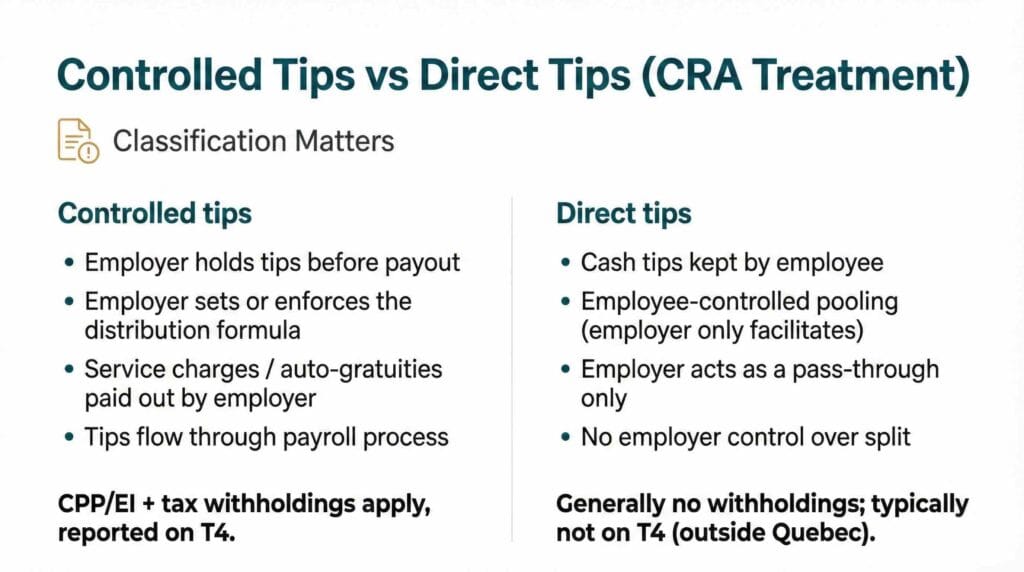
CRA also has a dedicated page on the tax treatment of tips received by employees, including how controlled tips flow through payroll reporting.
This is the spot where I see businesses stumble in tips and gratuities payroll BC. They do one of two things.
- They treat direct tips like controlled tips and over-withhold, and employees get frustrated because they lost tips to deductions they didn’t expect.
- They treat controlled tips like direct tips and under-remit, and the business gets stuck cleaning it up later, often at year end.
It’s also common for a business to have both types at the same time. For example, an employee receives cash tips directly, while card tips are deposited to the business bank account and later distributed under an employer policy. That’s why it’s worth documenting your policy, not just your intent.
How to classify tips and gratuities payroll BC as controlled or direct
If you want a practical test, use control and custody.
Ask these questions:
- Did the money land in the business bank account first?
- Did the employer decide the split, or enforce a mandatory formula?
- Did the employer hold the funds, even temporarily, before payout?
The more yes answers you have, the more likely the tips are controlled for CRA purposes.
On the other hand, ask this set:
- Did the employee receive the tip directly from the customer?
- Did employees decide how to pool and split, with the employer only facilitating?
- Could the employer change the split if they wanted to?
The more yes answers here, the more likely you’re dealing with direct tips.
In tips and gratuities payroll BC, it’s worth writing down the facts for your specific business, because the right answer depends on how you actually operate, not what your POS is capable of doing.
A BC-friendly tip pool workflow that stands up to questions
Tip pooling is allowed in BC, but the workflow has to prove two things. The employer is not keeping tips, and the distribution matches the policy consistently.
In practice, policy plus proof is what keeps tips and gratuities payroll BC from turning into a weekly argument.
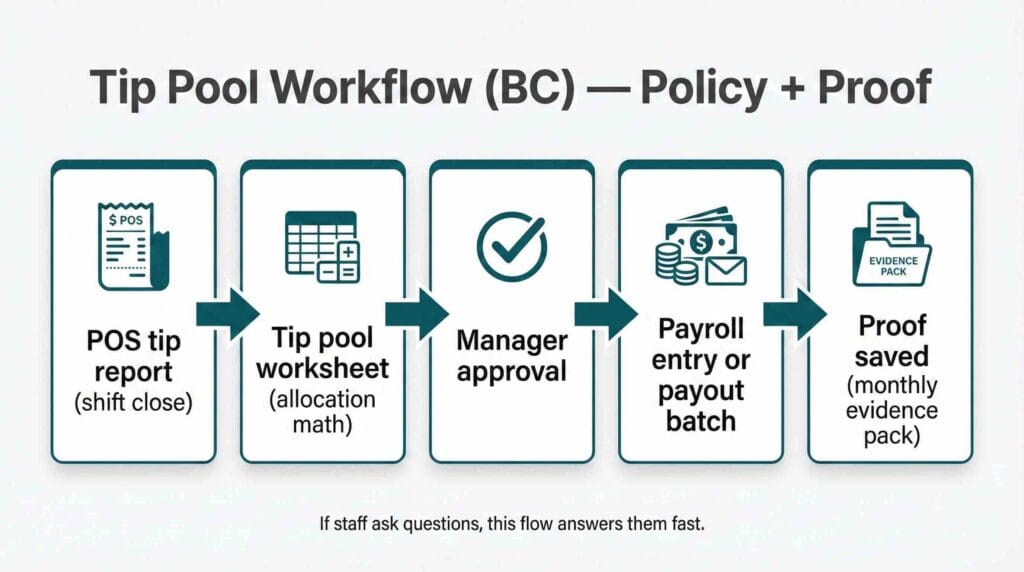
A clean workflow usually includes:
- A written tip policy that names who participates, how allocation works, and when payouts happen.
- A POS tip report at shift close as your input record.
- A simple tip pool worksheet showing the allocation math as your calculation record.
- A manager approval step before payroll is run as your control.
- Proof of payout, like a payroll register, e-transfer list, or signed cash payout sheet.
You do not need to make this fancy. You do need to make it repeatable.
If you want to tighten controls further, separate the roles. The person approving tip pool totals should not be the same person who edits payroll entries and releases payments. In a medium-sized operation, that separation is one of the easiest ways to prevent small issues from becoming expensive ones.
If your broader payroll process needs tightening too, it’s worth reviewing CRA payroll audit risk and documentation practices so you know what issues tend to trigger deeper questions.
Payroll setup pitfalls: overtime, stat pay, and the blended wage mess
Even when your tip pool policy is solid, payroll system setup can create problems.
The biggest issue is blending tips into hourly wage lines inside payroll. It feels convenient because it creates one payment amount. But it creates confusion later, especially when you need to explain overtime, statutory holiday pay, and year-end reporting.
BC guidance around gratuities is one reason to keep your reporting clean. Tips are regulated, but they are not treated like wages for every purpose. When tips are mixed into wages, your pay stubs become harder to interpret, and your backup becomes harder to defend.
Here are four messes I see regularly in tips and gratuities payroll BC.
- Misclassifying controlled and direct tips. This drives either over-withholding or under-remitting.
- Paying tip pools out of sales or revenue accounts. That can make it look like the business earned the tips.
- Using the wrong timing. The POS shows tips earned this week, but payroll pays a different period, and nobody can reconcile it.
- Letting a manager fix it later approach creep in. Tip adjustments happen after payout, and the file never fully ties out again.
If you want a simple rule: keep tips as tips, wages as wages, and use your accounting file to show the flow clearly.
For restaurants and bars, this ties closely to your payroll fundamentals. If it helps, review restaurant payroll structure so tips sit cleanly inside a compliant payroll process.
How to keep tip records clean in QuickBooks Online (without overbuilding it)
If you use QuickBooks Online, the goal is not to track every tip detail inside QBO itself. The goal is to create a clear audit trail that ties the POS records to payouts and bank deposits.
In tips and gratuities payroll BC, the cleanest setup uses clearing and liability accounts so you can reconcile without guesswork.
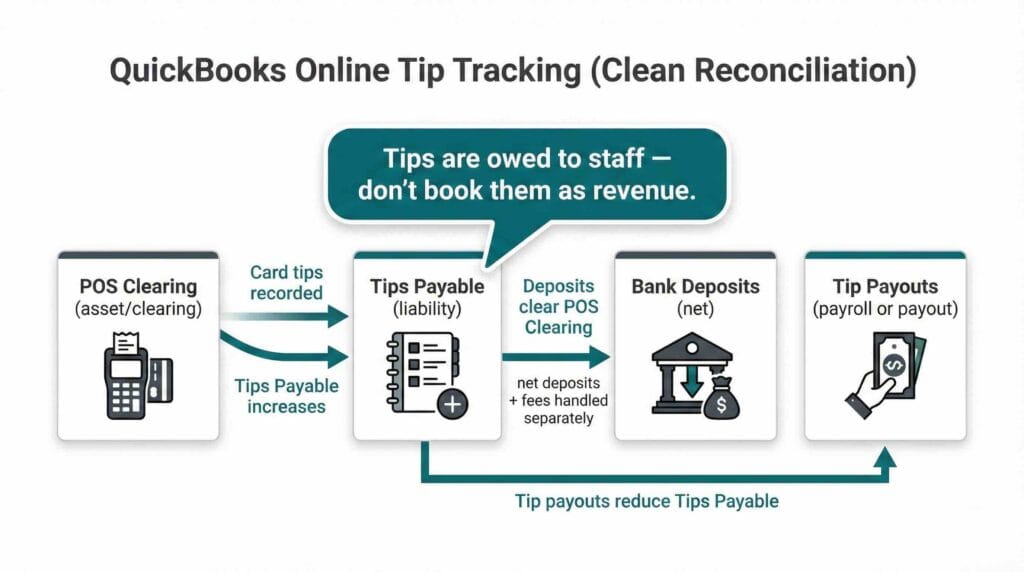
A practical account structure looks like this:
- Tips Payable or Tip Pool Payable as a liability. This shows tips you owe staff, not revenue you earned.
- POS Clearing or Card Clearing as a clearing account. This helps you match gross sales, fees, and net deposits.
- Merchant Fees as an expense. Keep fees separate so deposits make sense.
Once those accounts exist, your monthly close becomes a routine instead of a scramble.
- Tie POS card tips to the movement in Tips Payable.
- Tie tip payouts to payroll registers or payout reports.
- Clear POS or Card Clearing by matching gross sales less fees to actual deposits.
- Attach the backup documents to the month-end close, including POS tip summary, tip pool worksheet, and payroll register.
If you already struggle with deposit matching, this pairs well with a tips cleanup because the same clearing logic applies. See POS deposit matching and clearing logic for a clean setup approach.
And if your close process is inconsistent month to month, this is the broader backbone that keeps everything steady. Use this month-end close framework to keep reconciliations and documentation from piling up.
A simple reconciliation example you can copy
Let’s say your POS shows $4,000 in card tips for the pay period.
Step 1: When deposits hit the bank, the gross activity runs through POS Clearing.
Step 2: The $4,000 in tips is credited to Tips Payable as a liability, not income.
Step 3: When you pay out tips, via payroll or a separate payment, you debit Tips Payable and credit bank.
Now, when a manager asks where did the tips go, you can show the chain from POS report total tips, to liability created, to liability paid out.
That’s what a clean tips and gratuities payroll BC audit trail looks like in the real world.
What to document for 2026 (so you can answer questions fast)
Good documentation is boring until the day it saves you.
At minimum, keep a monthly evidence pack that includes:
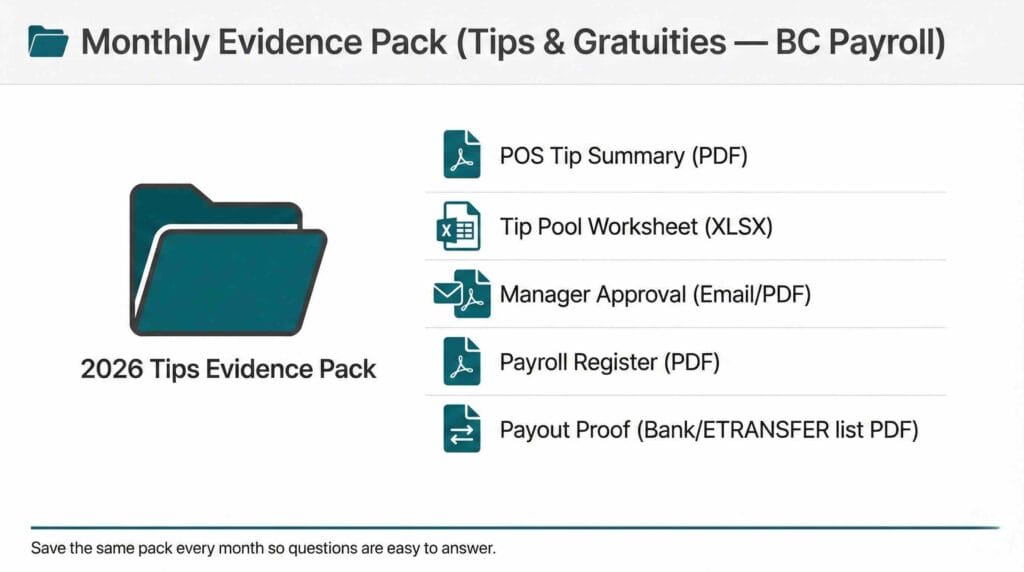
- POS tip summary reports by pay period.
- The tip pool worksheet showing allocation.
- Manager approval record, like a signed sheet, email approval, or workflow approval.
- Payroll register showing tip amounts when paid through payroll, or payout report if paid outside payroll.
If your team is already moving to a paperless workflow, that pack can live inside QBO attachments or a shared folder with consistent naming.
If you want practical guidance on keeping records tidy across the board, it’s worth reading about documentation habits overall.
Quick compliance checklist for tips in BC payroll
Use this as a fast self-audit for tips and gratuities payroll BC. Keep it tight, keep it practical, and fix one weak spot at a time.
- Written tip policy exists and matches how you actually operate.
- Tip pooling rules are clear: who participates, allocation method, timing.
- Tips are not withheld or deducted in prohibited ways under BC rules.
- Managers only participate where permitted and defensible under BC guidance.
- Direct tips and controlled tips are clearly classified using CRA definitions.
- Controlled tips are processed through payroll with the correct withholdings.
- Direct tips are handled per CRA guidance, including reporting expectations.
- Tip pools run through a liability account, not an income account.
- POS tip totals reconcile to tip liability movements each pay period.
- Tip payouts reconcile to payroll registers or documented payout proofs.
- POS clearing reconciles gross sales, fees, and net deposits cleanly.
- Monthly evidence pack is saved and easy to retrieve.
If you’re unsure about controlled tips deductions, CRA’s Payroll Deductions Online Calculator can help you sanity-check withholding expectations. You still need to apply the correct controlled versus direct classification first.
When it makes sense to get a payroll review (and what it should include)
A tips cleanup is not just fixing entries. A good review should connect policy, payroll, and bookkeeping into one repeatable process.
For most BC operators, a practical package includes:
- A controlled versus direct tips assessment based on how you run tips today.
- A tip pool worksheet template that matches your policy.
- Payroll setup adjustments so tips do not get blended into wage lines.
- A QBO mapping update using Tips Payable and POS clearing, so deposits and payouts tie out.
- A short monthly checklist your manager can follow without calling you after every busy weekend.
If tips and gratuities payroll BC has been an ongoing friction point, this is one of those fixes that pays for itself quickly, because it reduces staff questions and reduces rework at month end and year end.
At Valley Business Centre, we’ve supported businesses across Metro Vancouver, Whistler, Squamish, and the Sea to Sky Corridor for more than 30 years with bookkeeping, payroll, tax preparation, and cloud accounting systems.
If you’re a BC employer in Vancouver, Surrey, Burnaby, Richmond, Coquitlam, or Langley and you want tips and gratuities payroll BC to run cleanly without last minute stress, reach out. We can help you tighten up tracking, reconcile deposits and payouts, and keep tip documentation organized so payroll and bookkeeping stay aligned and year end feels straightforward instead of stressful.
