

GST/HST on digital services Canada can feel like “just sales tax” until you see what happens when one wrong setting repeats on every subscription renewal. If your billing platform, payment processor, and accounting file are not aligned, a small tax coding issue can quietly compound for months and then land on your desk as a painful cleanup.
We wrote this for business owners, finance leads, and operations managers at growing Canadian businesses. It’s practical and systems-focused, because most problems show up in workflows and configuration, not in a lack of effort. This is not personal tax advice, and it’s not a substitute for advice based on your specific facts.
GST/HST on digital services Canada is a systems issue in 2026
Digital revenue tends to scale in a very particular way. Subscriptions renew, usage charges post automatically, and upgrades follow the same billing rules month after month. That’s great when everything is set up correctly. It’s also exactly why GST/HST issues can become expensive, because the same mistake repeats hundreds or thousands of times.
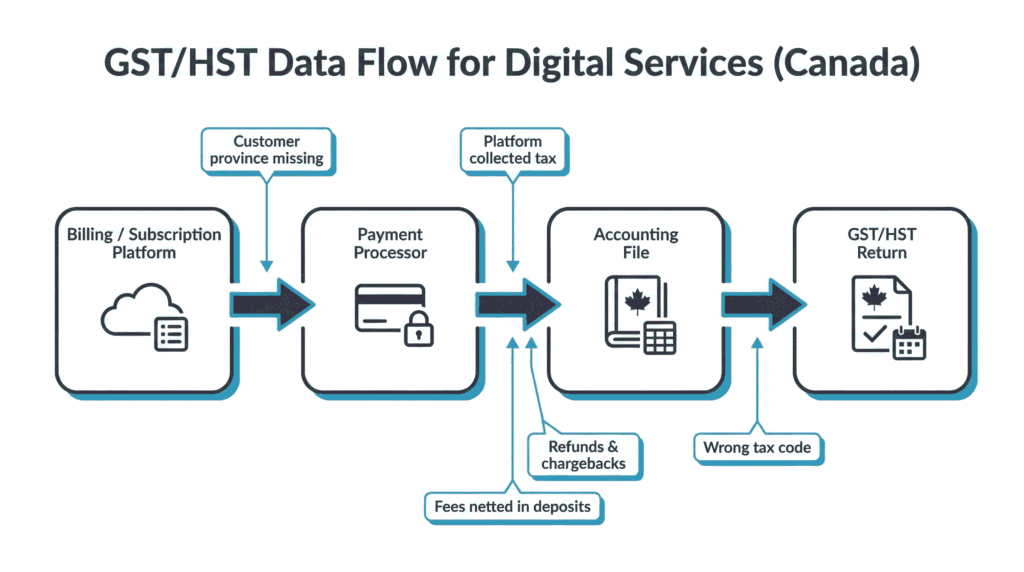
When we review files for digital businesses, the root cause is usually inconsistent setup across tools. One system thinks the item is tax-exempt, another applies a default rate, and a third uses a customer address field that is not the one you thought it was using. Your books can still “balance,” but the GST/HST can drift without anyone noticing until filing time.
In 2026, the practical goal for GST/HST on digital services Canada is straightforward: set the rules once, apply them consistently across systems, and keep enough evidence that you can support your treatment if CRA ever asks.
If you’re already leaning into automation, it’s worth remembering that automation amplifies both good and bad configuration. The thinking in bookkeeping automation applies directly here: clean item mapping and locked tax settings are what make “hands-off” processing reliable.
What counts as “digital services” in practice
Most businesses don’t label their products “digital services.” They sell subscriptions, access, hosting, membership content, digital training, or app functionality. The GST/HST questions usually show up later, when someone asks why customers in different provinces were charged the same rate, or why GST/HST wasn’t charged at all.
Here are common examples that tend to trigger GST/HST on digital services Canada questions in the real world:
SaaS subscriptions (per seat, per user, tiered plans, or usage-based billing).
Cloud hosting, storage, API access, and app subscriptions.
Digital memberships and gated content.
Online courses, coaching, or paid communities delivered digitally.
Downloadable products like templates and digital files, or streaming access.
Platform-facilitated sales through marketplaces and app stores.
CRA’s overview of the digital economy measures is a solid starting point when you want to understand the framework at a high level: GST/HST for digital-economy businesses.
The business takeaway is simple: don’t rely on labels like “software” or “online” when you’re setting up tax codes. What matters is how your supply is treated and, just as importantly, how your systems apply that treatment consistently.
The core GST/HST question: where is your customer?
For many digital businesses, the operational challenge isn’t “what did we sell?” It’s “where is the customer?” GST/HST rates depend on place-of-supply rules, and those rules determine whether you charge GST at 5% or HST at the applicable provincial rate. CRA’s place-of-supply guidance is here: GST/HST rates and place-of-supply rules.
That leads to a very practical requirement: your invoicing system needs a reliable customer billing address and province. Not “sometimes.” Not “if the sales rep remembers.” Reliable.
Here’s what we see most often when a business relies on manual entry or loose customer setup. A customer is created with no province, so the system applies a default rate. A customer moves, but the billing address never gets updated. Or the platform uses a “contact” address that was never meant to drive tax logic. Each one sounds minor. Together, they create a pattern of inconsistent GST/HST on digital services Canada reporting that’s hard to untangle later.
A practical control that works in most tools is making “province” mandatory for Canadian customers and limiting who can edit tax settings. If you’re using QuickBooks Online or Xero, it also helps to standardize your products and services so staff aren’t building one-off invoice lines that bypass your rules.
If you’re still deciding between platforms, this is one of those places where the details matter. In our experience, teams make better decisions when they compare how each system handles items, sales tax logic, and locked periods. The comparison in QBO vs Xero Canada (2026) is a helpful reference for growing teams that need strong controls.
Common GST/HST coding mistakes in software, and how to prevent them
Most GST/HST on digital services Canada problems show up as coding mistakes, not math mistakes. The system calculates perfectly, just on the wrong base, at the wrong rate, or using the wrong item setup.
Mistake 1: treating subscriptions as tax-exempt by default
This is more common than many owners expect. A file gets set up quickly, someone chooses “exempt” as a default, and the business under-collects GST/HST until a review catches it. Then the question becomes whether to absorb the difference or go back to customers, which is never a fun conversation.
Mistake 2: using one generic sales tax code for everything
If you sell into multiple provinces, a single generic code creates two issues. First, you’ll charge the wrong rate in at least one province. Second, you lose visibility. When you can’t break out taxable sales by rate or province cleanly, it’s much harder to do basic reasonability checks.
Mistake 3: zero-rating cross-border sales without documentation
Exports can be zero-rated in certain cases, but the conditions matter and the evidence matters. CRA’s reference point for exported services and intangible supplies is here: Exports – Services and Intangible Personal Property. If your checkout automatically sets 0% tax for “any U.S. address” without a documented policy and stored evidence, you’re building an audit risk into your workflow.
Mistake 4: mixing taxable and zero-rated sales under one item
If “Subscription Revenue” includes Canadian customers, non-residents, and platform sales, the income statement might look fine, but your GST/HST reporting becomes harder to support. When a question comes up, you want to trace the treatment back to a clear item and a consistent rule. Separating items by tax treatment and channel is often the simplest way to keep GST/HST on digital services Canada clean as you scale.
Mistake 5: double-taxing platform sales
Platforms can change who is responsible for charging and collecting GST/HST in certain situations. If the platform is required to collect, and you also charge tax on your invoice, you can end up with customer disputes, refunds, and messy reconciliations. CRA’s cross-border and platform-focused guidance is here: Cross-border digital products or services.
The operational point is to confirm who collects, then set your invoicing and item mapping to match that reality. It’s not enough to “know” the answer. Your systems need to behave the same way every time.
Controls that prevent repeat problems
You don’t need a complicated tax engine to get most of the benefit. You need a consistent setup that your team can follow without guesswork.
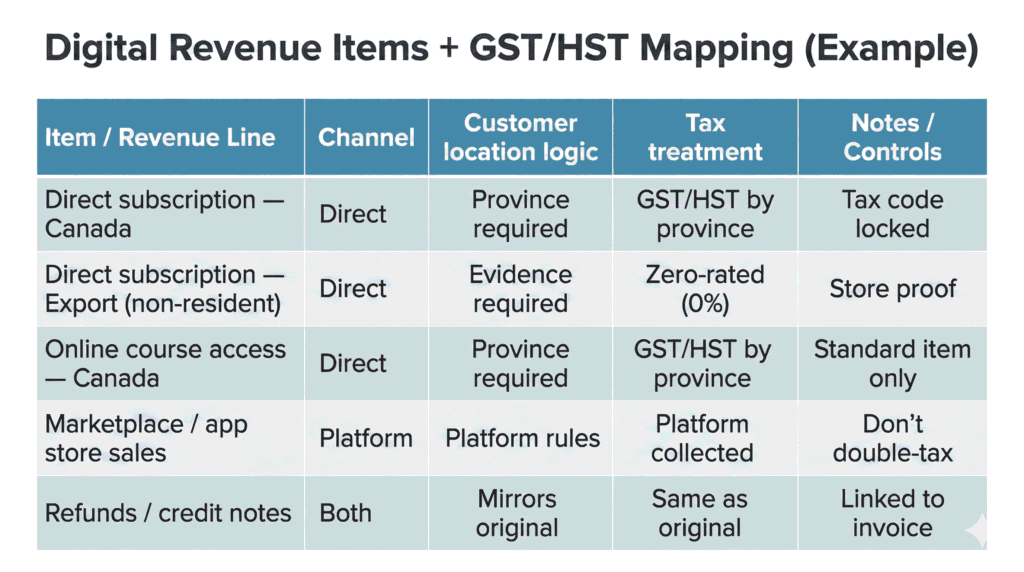
In practice, we recommend keeping a small set of standardized digital revenue items mapped to the correct tax treatment, locking down who can edit tax rates and tax codes, and then building one monthly habit: a reasonability check that compares tax collected to taxable revenue by province and channel.
If you want a simple monthly discipline that your team can repeat, the same rhythm that supports a clean close supports clean GST/HST.
The checklist approach in the month-end close process adapts well here, because GST/HST errors are much easier to fix in the month they happen than after year-end.
GST/HST on digital services Canada: a simple coding map you can actually maintain
Most businesses don’t need 40 different items. They need a small set that reflects how they actually sell.
A practical approach that works for many teams is to separate by channel first, then by customer location category your systems can support. For example, direct sales are usually handled differently than platform sales. Within direct sales, you may need different treatment depending on whether the customer is in Canada and which province they are in, or whether the supply qualifies for zero-rating in an export scenario.
The best test is whether a staff member can look at an invoice line and immediately understand why the tax treatment is what it is. If you can’t explain it quickly, your setup may be too complex, or too dependent on tribal knowledge.
This is also where reconciliation discipline matters. If you sell through ecommerce or subscription platforms, your payout statements often bundle fees, taxes, refunds, and currency conversion. If your bookkeeper is left to “figure it out” each month, you’ll see inconsistent coding and inconsistent GST/HST on digital services Canada reporting.
For platform-heavy businesses, the workflow thinking behind POS integration is still relevant. The details differ, but the principle is the same: reconcile deposits and payouts back to a clear sales and tax record, and keep the supporting statements.
Cross-border selling basics for digital services
Cross-border is where GST/HST on digital services Canada can feel complicated, mostly because the facts matter. The good news is you don’t need to memorize everything to improve your outcomes. You need a consistent onboarding process and documentation that matches how you’re treating each sale.
Canadian sellers with non-resident customers
Some exported services and intangible supplies may be zero-rated when conditions are met. Again, the CRA reference for exported services and intangible supplies is here: Exports – Services and Intangible Personal Property.
Where we see businesses get into trouble is treating “non-resident” as a checkbox without keeping the evidence. If your system treats the sale as zero-rated, your files should show why. That usually means capturing a consistent billing address, maintaining contracts or terms that describe the supply, and keeping proof of payment tied back to the invoice.
Non-resident selling into Canada, and Canadian buyers purchasing digital services
CRA’s digital economy rules can require GST/HST collection in certain scenarios, and platform rules can affect who collects and remits. If you need the framework reference point, start here: GST/HST for digital-economy businesses, then cross-check the more specific guidance in Cross-border digital products or services.
For Canadian buyers, the bookkeeping outcome is often about vendor setup and correct tax coding on expenses. If tax is being charged unexpectedly, or if you believe you should be self-assessing in a particular scenario, you want to catch it early and document your reasoning. This is another place where a monthly close process prevents year-end surprises.
At a planning level, the most helpful question to ask internally is whether you sell primarily B2B or B2C, and what evidence you capture to support that. That decision influences how you configure onboarding, invoices, and customer records, and it’s a key building block for reliable GST/HST on digital services Canada treatment.
Recordkeeping checklist for an audit-ready trail
Good recordkeeping is what makes GST/HST on digital services Canada manageable. You do not want to rebuild evidence after the fact. You want your systems to produce support as part of normal operations, so if a question comes up, you can answer it without scrambling.
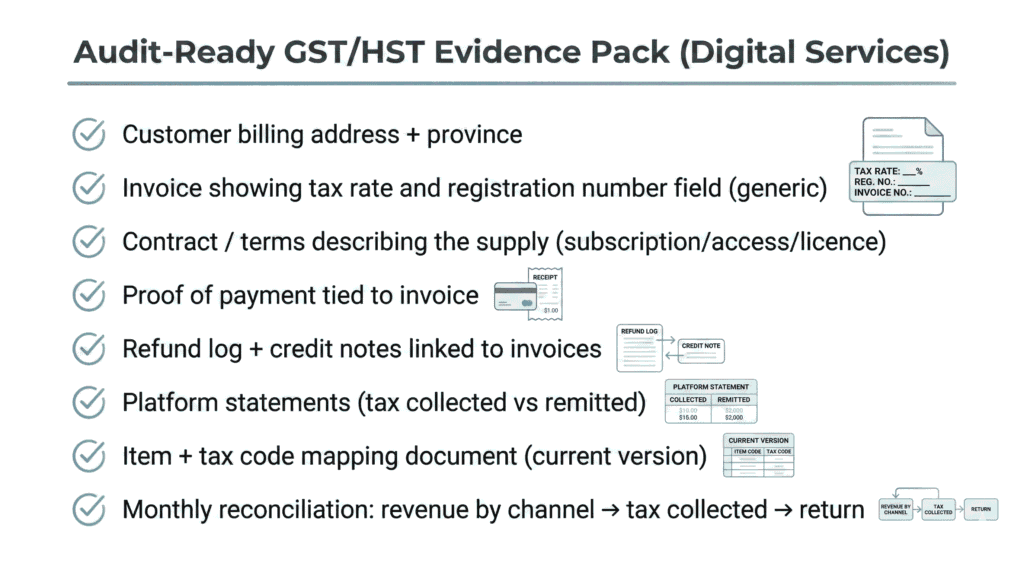
In a real review or cleanup, we usually want to see customer location evidence (billing address and province, plus any other reliable indicators your systems store), invoices that show the GST/HST rate and your registration number where applicable, and contracts or terms that describe what is being provided (subscription access, licence, support, or digital delivery).
We also look for proof of payment, refunds and credit notes tied back to the original invoices, and platform statements when a marketplace is involved. Finally, a simple mapping document that shows which items use which tax codes is extremely helpful. It turns your GST/HST on digital services Canada approach from “we think it’s set up right” into “here’s exactly how it’s set up and why.”
If you’ve ever had to reconstruct platform payouts, you already know why this matters. One clean reconciliation file per month is worth far more than a heroic cleanup at year-end.
A practical month-end GST/HST check that catches issues early
Most leaders don’t want more reporting. They want one quick check that makes problems obvious.
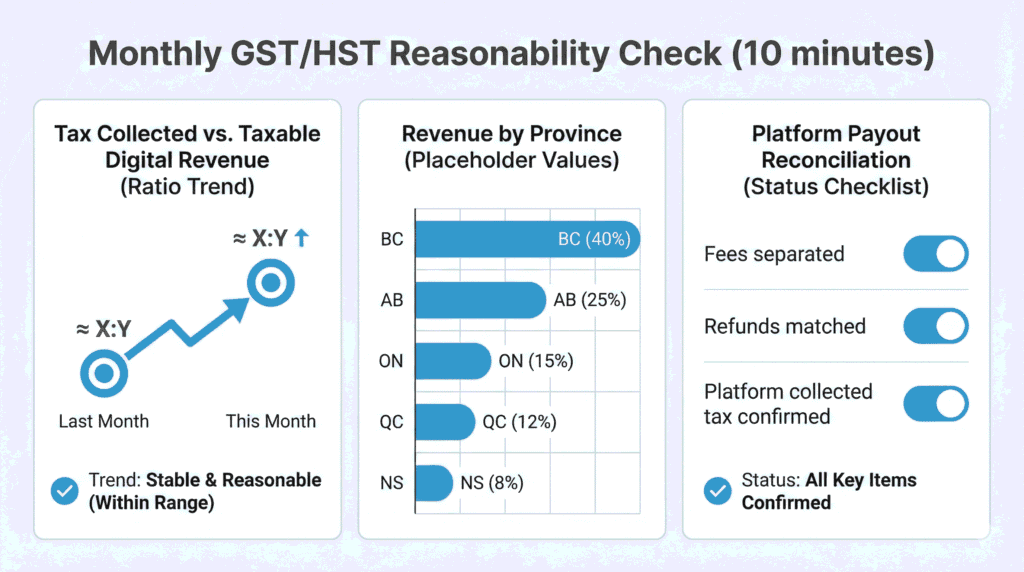
A simple GST/HST on digital services Canada check can be done monthly in a few minutes if your system is set up with clean items and tax codes. Start by comparing taxable digital revenue for the month to GST/HST collected. If the ratio looks off compared to prior months, investigate. Then scan revenue by province or customer region, depending on what your tools can reliably produce. If one province suddenly spikes, you want to know whether that’s real growth or a coding issue. Finally, reconcile platform statements to recorded revenue and confirm whether tax was collected by you or by the platform.
These checks aren’t about perfection. They’re about catching drift. Drift is what creates big cleanups and stressful filing cycles.
If you want a cash and operational lens on this, it’s worth tying GST/HST into your short-term planning. Tax remittances are real cash outflows, and strong forecasting helps avoid surprises. The approach in 12-week cash flow forecasting is a helpful companion for teams that want predictable remittances rather than last-minute scrambling.
When to get a GST/HST setup review for digital services
You don’t need a review every time you add a new feature. But it’s smart to consider a GST/HST setup review when something changes that affects how your systems apply tax.
In our experience, it’s worth reviewing your GST/HST on digital services Canada setup if you’ve expanded into additional provinces and kept the same tax code, started selling through platforms and you’re not sure who collects, introduced usage-based billing or bundles, switched billing tools or accounting systems, or if your GST/HST payable balance doesn’t make intuitive sense month to month.
For many teams, the most valuable output is a clean, documented mapping: which items are used for which sales, what tax codes apply, and what evidence supports cross-border or platform treatment. Once that’s in place, your bookkeeper can keep it consistent and your leadership team can focus on growth instead of recurring cleanup work.
From a risk standpoint, GST/HST on digital services Canada is rarely about one big wrong decision. It’s usually many small inconsistencies that quietly repeat. Fixing the system is what keeps the problem from coming back.
At Valley Business Centre, we’ve supported businesses across Metro Vancouver, Whistler, Squamish, and the Sea to Sky Corridor for more than 30 years with bookkeeping, payroll, tax preparation, and cloud accounting systems.
If you’re a BC business selling SaaS, subscriptions, online courses, or platform-based digital products in Vancouver, Surrey, Burnaby, Richmond, Coquitlam, or North Vancouver and you want GST/HST reporting that stays consistent as you grow, reach out. We can help you tighten up tracking, reconcile deposits and payouts, and keep documentation organized so filing and year end feels straightforward instead of stressful.
