

Accounts receivable process problems are one of the most common reasons profitable Canadian businesses still feel cash tight. If you’ve ever looked at your sales, felt good about the month, then stressed about payroll a week later, you’ve seen it firsthand. The work is done. The invoices are out. The cash is not in.
A dependable accounts receivable process closes that gap. It keeps cash coming in on a predictable rhythm so you can pay people, pay vendors, and plan properly.
This article lays out a practical, Canadian-friendly AR collections system you can actually run in 2026. Not theory. A real rhythm with terms, invoicing habits, a 30/60/90 follow-up cadence, reporting, and a short list of KPIs that keep you out of surprise mode.
You will notice a theme: you do not need to become aggressive. You need to become consistent. A consistent accounts receivable process does the heavy lifting.
Why AR is the silent cash flow killer for Canadian service businesses
Most AR problems don’t start with bad customers. They start with optional process.
When the accounts receivable process is loose, little delays stack up. You invoice a few days late. The client routes it to the wrong approver. A PO is missing. Someone says they didn’t receive it. Your team follows up when they remember, not on a schedule.
Meanwhile, your costs are real-time. Wages, subcontractors, rent, software, fuel, interest on the line of credit. Cash leaves on time even when cash arrives late.
If you want a useful gut-check, compare these two statements.
- We had a strong month.
- We have enough cash for the next two payroll runs without leaning on the LOC.
A strong accounts receivable process bridges that gap and makes your cash position more predictable.
If cash planning is already a priority, pair a tighter accounts receivable process with your forecasting routine. Your AR system will make your forecast far more accurate, because you’ll have dates you can believe. Here’s a practical resource on 12-week cash flow forecasting that fits well with a tighter collections rhythm.
The accounts receivable process that prevents late payments before they happen
Collections starts earlier than most owners think. If you only start doing AR once the invoice is overdue, you’re already behind. A good accounts receivable process prevents a chunk of late payments before they even start.

Here are the three upstream controls I see make the biggest difference.
First, tighten your terms in writing. Don’t bury them. Put them in your quote, contract, engagement letter, and onboarding email. This is where your accounts receivable process starts.
At minimum, your terms should clearly state your payment terms, accepted payment methods, who approves invoices on the client side, and what happens if payment is late.
Second, do a pre-billing confirmation. This is the easiest win for service firms and it strengthens your accounts receivable process immediately.
Before sending the invoice, confirm the deliverable or milestone is signed off, the bill-to contact and address are correct, the PO or reference number is included if required, and the client knows the invoice is coming and how they’ll pay. This one step eliminates a huge chunk of it’s stuck in approvals and we never got it delays.
Third, clean up invoice hygiene as part of your accounts receivable process.
Your invoice should be easy to approve and easy to pay. That means clear scope description and dates, a visible due date, reference fields filled in, a payment link if you use online payments, and one simple line telling them how to resolve billing questions.
If you are still emailing a PDF with no payment options and hoping for a cheque, you’re choosing slower cash. If you’re modernizing your billing workflow, this guide on paperless invoicing is a solid next step.
A 30/60/90 workflow you can run every week without chaos
A common mistake is treating follow-up like a mood. You feel awkward, you delay it, then you overcorrect at day 75 and it gets tense.
Instead, run a standard cadence. Your customers will actually respect it more because it feels professional and predictable. This is the part of the accounts receivable process that most businesses skip, and it is exactly why AR gets messy.
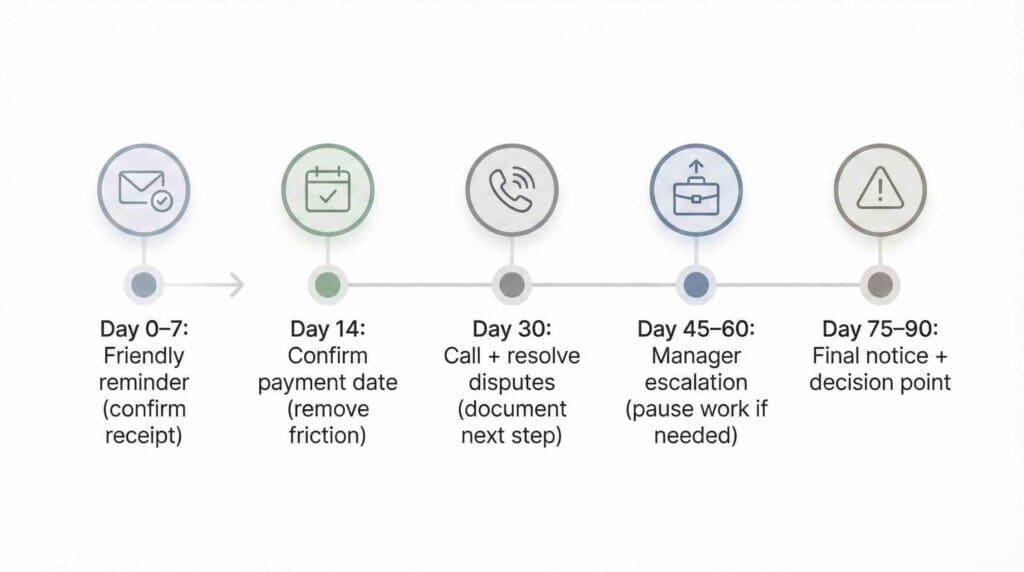
A simple accounts receivable process for day 0 to day 7
This is your assume good intent window.
Use a short subject line like: Invoice 123 due on date.
Keep the message tight.
Hi [Name],
Just a friendly reminder that invoice 123 for X is due on date. Can you confirm it was received and let us know the expected payment date?
Thanks, Your name
Your goal is simple: confirm receipt and get a payment date. In a healthy accounts receivable process, this message goes out every week without drama.
Day 14: confirm the payment date and remove friction
This is where you stop being vague and start getting a specific commitment. It is also where an accounts receivable process starts to feel professional on the client side.
Hi [Name],
Checking in on invoice 123. Can you confirm the payment date you have scheduled? If it helps, we can accept EFT, PAD, credit card, or e-transfer, and resend any supporting details you need for approval.
Thanks, Your name
Your goal is to get a date, remove obstacles, and make it easy to pay.
Day 30: call, resolve disputes, document next steps
At 30 days, an email chain can become a hiding place. A short call brings reality back into the conversation. A strong accounts receivable process uses the phone before the situation hardens.
Here is a simple call script you can use.
Hi [Name], I’m calling about invoice 123 for X. Can you confirm status?
If it’s in approvals, who is the approver and what date is it scheduled for?
If there’s an issue, what’s the specific concern and what would resolve it?
Close with: Great. I’ll email a quick recap of the next step and the date we agreed on.
Your goal is to turn vague delay into a trackable next step with an owner and a date.
Day 45 to day 60: escalation to a manager or owner
If the balance is meaningful, you escalate professionally. This is still part of a normal accounts receivable process, not a personal conflict.
Your escalation message should do three things. Confirm the amount and invoice numbers. Summarize prior follow-ups with dates. Set a firm next action with a deadline.
Example language, keep it calm:
Hi [Name],
I’m stepping in to help resolve invoice 123 for X, now 45 days past due. We’ve followed up on dates and are still missing a confirmed payment date. Please confirm payment by date. If we do not receive confirmation, we will pause further work until the balance is resolved.
Regards, Manager or Owner
Day 75 to day 90: final notice and decision point
At this stage, you decide whether the account is collectible, needs a payment plan, or should move to a collection or legal process. A disciplined accounts receivable process makes this a decision, not a guess.
Keep the final notice objective. Amount outstanding, invoice numbers, original due dates, final deadline, and the next step if it is not resolved.
If you do move toward formal steps, make sure your documentation is in order and your retention practices are solid. CRA’s guidance on keeping records is a helpful baseline.
Payment options that speed up cash without creating admin headaches
You don’t fix AR only by chasing. You fix it by making payment easy and delay uncomfortable. Payment friction is one of the quiet killers of an accounts receivable process.
In 2026, most Canadian businesses should offer at least two fast payment options. Three is better.
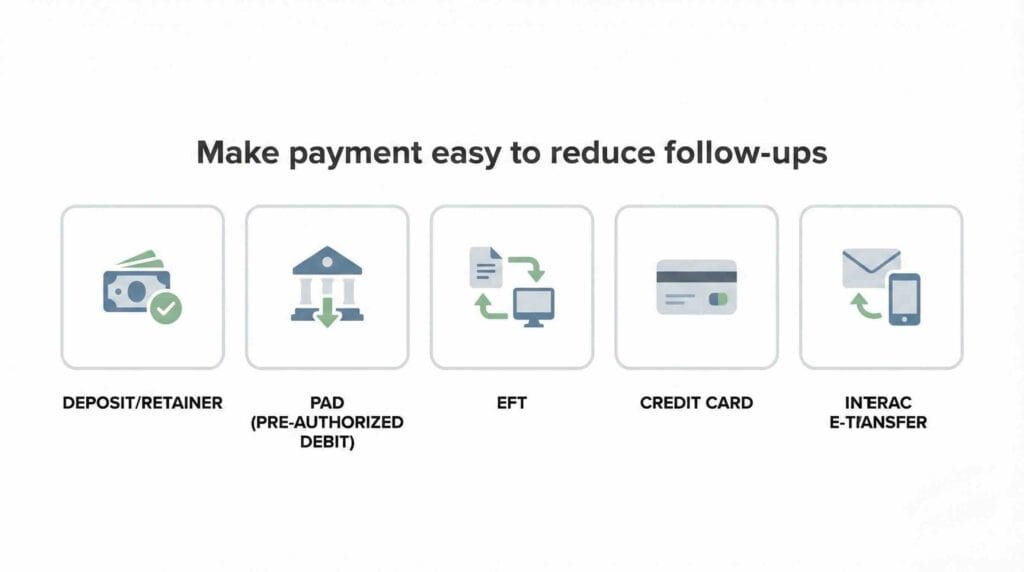
Deposits or retainers can be the best lever for project work. They align expectations, reduce your exposure, and keep the client engaged in the payment rhythm. For many service firms, deposits are the simplest upgrade to the accounts receivable process.
Pre-authorized debit is excellent for recurring services like monthly bookkeeping, managed services, maintenance, and retainers. If you want a plain-language overview, the FCAC page on pre-authorized debits is worth a quick read.
EFT works well for B2B, removes cheque delays, and is usually lower cost than cards. For background on the Canadian payments ecosystem, see Payments Canada.
Credit cards are fast, but fees matter. Decide in advance whether you absorb fees, restrict card payments to smaller invoices, or price accordingly. The key is to decide once, then apply it consistently across the accounts receivable process.
Interac e-Transfer can be practical for smaller invoices and faster settlement. Interac has a business overview here: Interac e-Transfer for business.
The admin rule that keeps this manageable is standardize. Pick your approved payment methods, set them up cleanly in your accounting system, and write them into your onboarding and invoice footer. A consistent accounts receivable process should reduce exceptions, not increase them.
Reporting that makes AR feel under control
If you want AR to stop feeling like a fire drill, you need two reports and one short meeting. Reporting is what turns an accounts receivable process into a real system.

First, the AR aging report. This is the non-negotiable. Review it weekly, not monthly. Keep your buckets consistent, such as Current, 1 to 30, 31 to 60, 61 to 90, and 90 plus.
Second, a dispute tracker. This can be a simple spreadsheet. What matters is ownership and next step. Track the customer, invoice number, amount, reason, owner, next step, target date, and notes. If disputes are frequent, treat that as a signal that your accounts receivable process needs earlier confirmation and cleaner invoicing.
Third, a 15-minute weekly AR huddle. This is not a long meeting. It’s a routine. Review your top balances, anything about to roll into 30 plus days, disputes blocking payment, and accounts that need escalation.
If you already run a month-end routine, make AR review part of it so nothing piles up. This month-end close checklist is a good framework to anchor that habit.
KPIs owners and managers should track in 2026
Most businesses track too many numbers and still miss the point. AR KPIs should drive action, and they should support your accounts receivable process.
Days Sales Outstanding is one. Trend it monthly. If DSO is rising, your accounts receivable process is slipping. You don’t need a perfect benchmark across industries, you need your trend moving the right way.
Percent of AR that is current is another. If current is shrinking and 31 to 60 is growing, you need earlier follow-up, not tougher final notices. That is an accounts receivable process problem, not a sales problem.
Collection Effectiveness Index is useful when sales are seasonal because it helps normalize performance over a period.
Dispute rate and average time to resolve matters because unresolved disputes are expensive. If disputes are common, you likely have an upstream issue like unclear scope, missing documentation, or approvals not confirmed before invoicing.
Expected receipts in the next 14 days versus payroll is the no-surprises metric. If expected receipts cannot comfortably cover payroll, you do not wait. You push follow-up earlier, you call the top balances, and you fix the disputes. This is where the accounts receivable process protects payroll decisions.
This ties directly into cash planning and financing decisions, especially if you rely on a line of credit. If you want a deeper planning framework, revisit the cash flow forecasting playbook.
Templates you can copy into WordPress, email, or your accounting system
You do not need long scripts. You need consistent wording that your team can use without rewriting every time. Templates are a practical way to make the accounts receivable process consistent across staff.
Template 1, confirm receipt:
Hi [Name], just checking that you received invoice 123 for X due on date. Can you confirm the expected payment date? Thanks.
Template 2, confirm payment date:
Hi [Name], can you confirm the payment date scheduled for invoice 123? If you need any supporting details for approvals, reply here and we’ll send them right away.
Template 3, manager escalation:
Hi [Name], invoice 123 for X is now X days past due. Please confirm payment by date. If we do not receive confirmation, we will pause further work until the balance is resolved.
The trick is not the wording. The trick is using the same accounts receivable process every week.
Common mistakes that quietly break your AR system
I see a few patterns repeat across industries, and they all weaken the accounts receivable process.
Invoicing late is a big one. If you invoice late, you train your client to pay late. Fixing AR often starts with a simple service standard: invoice within 24 to 48 hours of milestone completion. Treat that as a non-negotiable step in your accounts receivable process.
Letting one special client ignore the rules is another. If you carve out exceptions, your team loses confidence in the process and follow-up becomes inconsistent.
No clear owner breaks the system quietly. Someone must own AR outcomes. That does not mean one person does everything, but it does mean one person is responsible for making sure the accounts receivable process runs on schedule and disputes move forward.
Not reconciling properly causes avoidable damage. If your deposits and payouts are not reconciled, you can end up chasing invoices that were already paid or misapplied. That burns relationships quickly.
If you want a straightforward read that connects AR discipline to stability, BDC’s guide to cash flow planning is a good reference.
How to implement this in the real world without overwhelming your team
A good rollout is simple and staged. Rolling out an accounts receivable process works best when you keep it boring and repeatable.
Week 1, clean up the basics. Confirm terms are written. Confirm invoice fields. Confirm your payment methods. Create the dispute tracker.
Week 2, start the cadence. Run the aging report. Do the first weekly AR huddle. Send day 0 to 7 reminders and day 14 confirmations on schedule. This is where the accounts receivable process becomes real.
Week 3, tighten your escalation path. Decide who sends manager escalations. Decide when work pauses. Decide what qualifies for a payment plan.
Week 4, measure and adjust. Track DSO, percent current, and expected receipts versus payroll. If a specific client type causes delays, adjust onboarding and pre-billing confirmations so the accounts receivable process stays clean.
If your team already feels stretched, remember this: a consistent accounts receivable process saves time. It reduces back-and-forth. It reduces disputes. It reduces awkward follow-up because everyone knows what happens next.
When it’s worth getting help with AR cleanup and an SOP
If your AR is materially overdue, you may need a one-time cleanup before the system can run smoothly. Think of it as resetting the accounts receivable process so it starts from clean data.
That cleanup usually includes matching payments correctly and fixing misapplications, writing off truly uncollectible balances with proper documentation, standardizing terms and payment methods, and building a weekly cadence your team can sustain.
If you want to compare how AR ties into your broader bookkeeping workflow, you may also like this guide on how to improve your accounts receivable collections.
Consider embedding a short explainer video on how to read an AR aging report from a reputable accounting educator or bookkeeping software channel. Keep it short so it’s actually watchable.
At Valley Business Centre, we’ve supported businesses across Metro Vancouver, Whistler, Squamish, and the Sea to Sky Corridor for more than 30 years with bookkeeping, payroll, tax preparation, and cloud accounting systems.
If you’re a BC business owner or manager in Vancouver, Surrey, Burnaby, Richmond, Coquitlam, or North Vancouver and you want your accounts receivable process to produce predictable cash receipts without awkward client conversations, reach out. We can help you tighten up tracking, reconcile deposits and payouts, keep documentation organized, and keep payroll and bookkeeping aligned so year end feels straightforward instead of stressful.
