
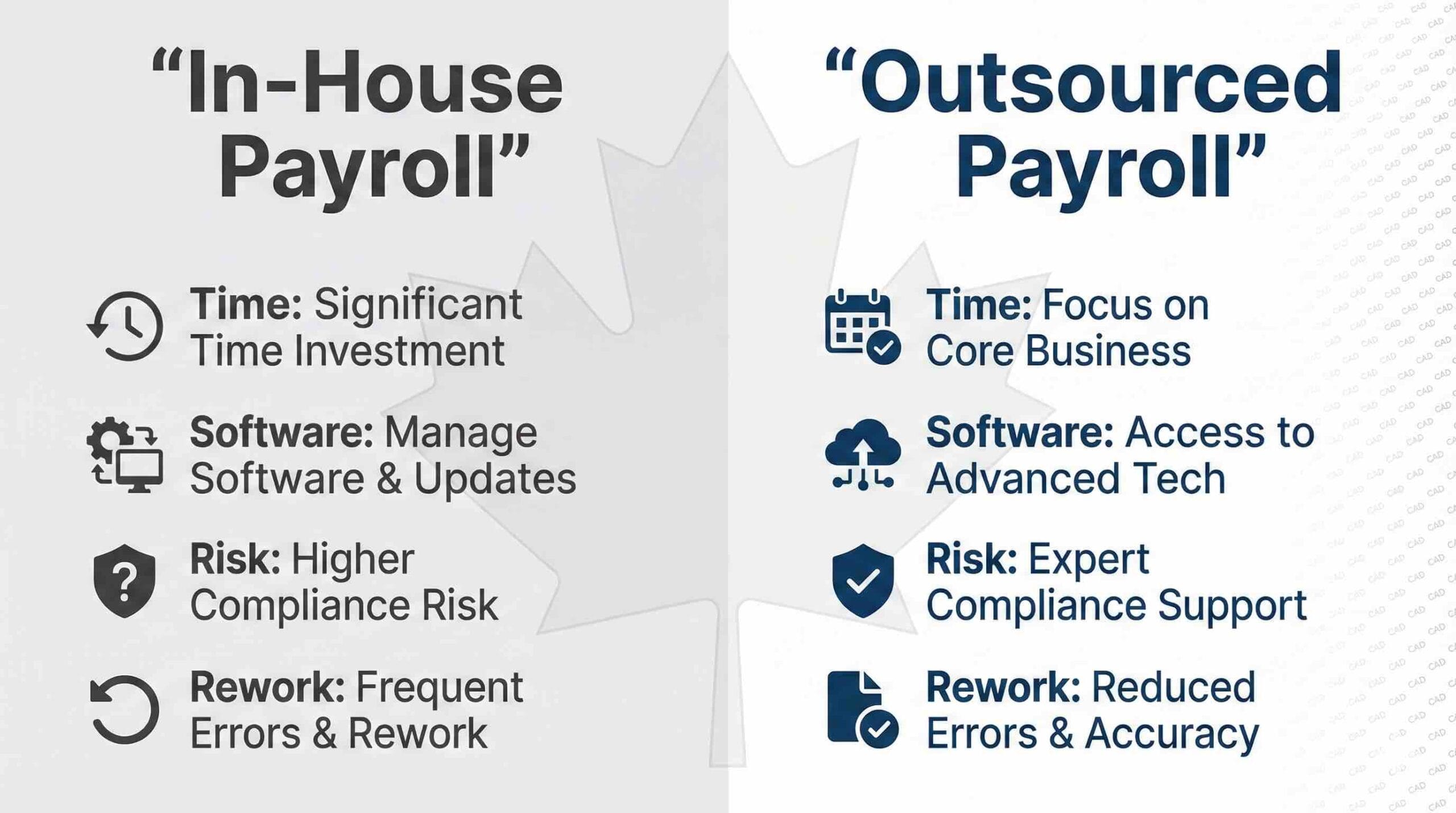
Payroll outsourcing vs in-house Canada is one of those decisions that feels “administrative” until it lands on your desk as a compliance problem, a cash problem, and a people problem all at once.
If you’re a small business owner or a decision maker in a mid sized company, you’re usually weighing two things at the same time: cost and control. The tricky part is that payroll cost is not just a software fee, and payroll control is not just “who clicks submit.”
In this 2026 guide, I’m going to walk you through what actually drives payroll cost in Canada (time, tools, risk, and rework), where in-house payroll typically breaks down, what outsourcing usually includes, and which controls matter most as your team grows. The goal is simple: help you choose a payroll model you can live with every pay period, not just the one that looks cheapest on paper.
Why this decision matters in 2026
When clients ask me about payroll, they often start with “We just need to pay people.” Fair. But payroll is also a compliance system and a cash movement system.
Every pay run touches real money, CRA remittances, employee trust, and your month-end numbers. A single mistake can create a chain reaction: corrected pay stubs, amended remittances, frustrated employees, and leadership time you did not plan to spend.
That’s why payroll outsourcing vs in-house Canada is not a minor ops choice. It’s a financial controls choice.
If you’re already feeling the strain, it usually shows up as one of these:
A payroll run that “only takes 45 minutes” but somehow consumes half a day.
Month-end close that gets delayed because payroll liabilities do not tie out.
Year-end that turns into a scramble for missing benefits, allowances, or termination details.
And if your payroll person is away, the whole process becomes fragile. That is a risk signal, not a staffing inconvenience.
The real cost model (time + software + risk + rework)
If you want an apples-to-apples comparison, you need a cost model that matches reality. For payroll outsourcing vs in-house Canada, I use four buckets with clients because they capture the true cost drivers.
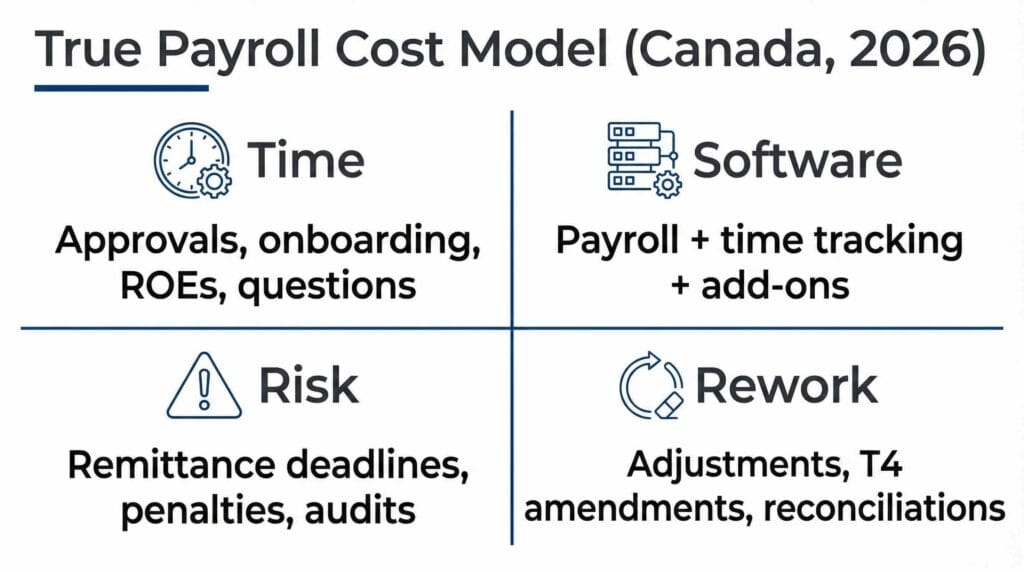
Payroll outsourcing vs in-house Canada cost model: time, software, risk, rework
First, let’s talk time. Not “how long it takes to press the button,” but the surrounding work that makes payroll correct.
Time tends to include onboarding, terminations, ROEs, vacation and stat pay calculations, overtime rules, tips or commissions, benefit setup, and answering employee questions. Year-end adds T4 preparation, reconciliations, and clean-up when something was tracked late.
Even if the pay run itself is quick, the supporting work is often the bigger number.
Second is software and add-ons. Most businesses start with payroll software, then add time tracking, scheduling, HR document storage, expense apps, and benefits portals. None of these are “wrong,” but the stack can get expensive fast, and it can get fragmented even faster.
Third is risk, meaning penalties, interest, and audit exposure. CRA expectations do not change because you were busy. Remittance deadlines still apply, and errors still require correction.
CRA outlines payroll remittance due dates and how to remit source deductions, including the penalty structure for late remittances, on its guidance page for employers. You can review the current details here: CRA payroll remittance due dates.
CRA also addresses employer responsibilities for payroll deductions and the consequences of failing to deduct properly in its employer guide: Payroll deductions and remittances guide.
Fourth is rework. Rework is the cost nobody budgets for, and it is the cost that makes payroll feel “expensive” even when the subscription fee looks small. Rework shows up as adjustments, T4 amendments, liability reconciliations, and management time spent fixing a story after the fact.
If you’re evaluating payroll outsourcing vs in-house Canada, you need to price rework honestly. If you do not, in-house will almost always look cheaper than it actually is.
A quick “true cost” example you can relate to
Here’s a scenario I see often. A business runs semi monthly payroll. The pay run takes an hour, but approvals, hour clean-up, and employee questions add another two hours. Terminations or onboarding add time sporadically. Month-end requires a liability reconciliation. Year-end needs a few concentrated days.
Now add just one problem pay period: a missed taxable benefit input, or a remittance that went in late during a vacation week. That single event can create a half day of rework, plus penalties, plus employee trust damage. Suddenly the “savings” of keeping payroll in-house looks a lot less certain.
What typically goes wrong in-house
In-house payroll can work well when it’s properly resourced, documented, and reviewed. The problems start when payroll becomes “owned” by one person with no backup, and the process lives in their head instead of in a repeatable workflow.
When clients ask me why their in-house payroll feels stressful, it’s usually one of these patterns.
Late or incorrect remittances
The most common failure is not malicious. It’s operational. Someone is away, bank signing changes, a remittance cadence shifts after growth, or a pay period falls on a holiday week.
CRA’s penalty structure can escalate based on how late the remittance is. If you want the exact breakdown and the current wording, use the CRA link above for remittance due dates and penalties: CRA payroll remittance due dates.
For mid sized employers, remitter type matters too, because it drives due dates and cadence. CRA explains remitter types and how they are determined (including the use of average monthly withholding amounts from prior periods) here: CRA types of remitters.
This is a big reason payroll outsourcing vs in-house Canada becomes a question as you scale. A process that worked when you were a small remitter can become risky when your cadence changes and nobody updates the calendar, approvals, and review steps.
Failure to deduct properly
The second common issue is deductions. This can show up as CPP/EI being missed for certain pay types, taxable allowances being treated incorrectly, or a payroll setup error that goes unnoticed for months.
CRA addresses employer obligations and penalties related to deduction errors in its employer guide: Payroll deductions and remittances guide.
Even when you catch the issue internally, you still have the downstream work: adjustments, explanations to employees, and fixing your payroll liability accounts so your financial statements make sense again.
Taxable benefits get missed or handled late
Taxable benefits are the classic year-end surprise. Company vehicles, allowances, gifts and awards, certain benefits premiums, and a few other items can sneak up when the business is busy.
CRA’s main reference is the taxable benefits guide: CRA taxable benefits and allowances guide.
What I see in real life is not that people ignore the rules. It’s that they plan to “deal with it at year-end,” then year-end arrives and the details are missing. That’s when payroll becomes a clean-up project instead of a predictable process.
If you are already running into taxable benefit surprises, payroll outsourcing vs in-house Canada is worth revisiting because it’s usually a process gap, not a software gap.
ROEs and terminations become a scramble
Terminations, layoffs, and leaves are where payroll precision matters most. Service Canada’s Record of Employment (ROE) requirements can create pressure because you need the right dates and earnings details on time.
Service Canada’s ROE resources are here: Record of Employment (ROE) information.
If ROEs are routinely last minute in your organization, it usually means your termination workflow is not documented or not owned clearly. Outsourced payroll can help, but only if roles are defined (who provides the info, who reviews, who submits).
Weak documentation and key person risk
CRA expects you to maintain records and supporting documents for years. In practice, documentation is also what protects you when an employee disputes hours, a benefit, or a termination payout.
And then there’s the big operational risk: one staff member knows how payroll works, and everyone else hopes they do not get sick or leave. That is not a sustainable control environment in a mid sized business.
If that sounds familiar, payroll outsourcing vs in-house Canada is not just about saving money. It’s about removing a single point of failure.
Outsourcing model: what’s included vs what isn’t
Outsourcing payroll can mean a few different things, so you want to be clear on the model before you compare fees.
In most engagements, outsourcing includes the recurring core:
– Pay runs on a schedule (salary and hourly).
– Source deduction calculations and remittance support.
– ROEs and termination processing support within scope.
– Year-end support for T4s and summaries.
– Standard reports for management and bookkeeping.
What is often not included unless you scope it:
– HR legal advice or policy drafting.
– Complex benefit plan design and negotiation.
– Historical clean-up of prior errors, unless you buy a clean-up package.
– Job costing allocations and deeper reporting setups, unless requested.
The biggest success factor is responsibility design. For payroll outsourcing vs in-house Canada to work, the business still needs clear internal ownership for inputs and approvals.
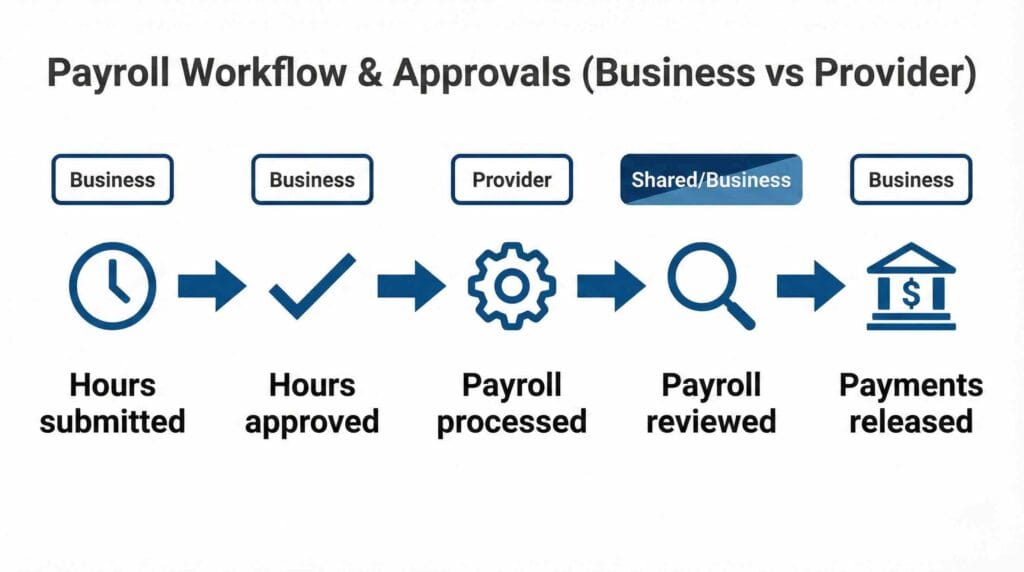
At a minimum, you want to define who approves hours, who approves pay changes, and who releases funds. I’m saying this plainly because I’ve seen the opposite: an outsourced provider waiting on approvals while the company assumes “outsourced” means “handled.” That gap is where payroll stress lives.
Medium-size angle: controls that matter
Once you’re beyond a handful of employees, payroll is not just a task. It’s a control environment.
Whether you choose payroll outsourcing vs in-house Canada, the controls below are what keep payroll stable through growth, turnover, and busy seasons.
Approvals and audit trail
You want a clear trail of who changed pay rates, who edited hours, and who approved the final run. If your current workflow involves text messages or hallway conversations, you do not have an audit trail. You have memories.
Good systems log changes. Good processes require approvals before money moves.
Separation of duties
In a medium sized company, having one person enter payroll, approve payroll, and release funds is not ideal. It does not mean they are untrustworthy. It means the system is vulnerable.
The practical approach is to separate roles where you can: one person prepares, another reviews, a third releases payments. Even in a small team, you can build a review step that prevents mistakes from becoming pay issues.
Remitter type awareness and calendar discipline
If your remitter type changes, your due dates can change. This catches growing businesses off guard.
CRA’s explanation of remitter types is here: CRA types of remitters.
You do not need to memorize every rule. You do need a reliable calendar, reminders, and someone accountable for confirming the cadence each year.
The payroll proof pack for month-end close
Here’s one of the simplest controls I recommend: a standard “payroll proof pack” that becomes part of your month-end close.
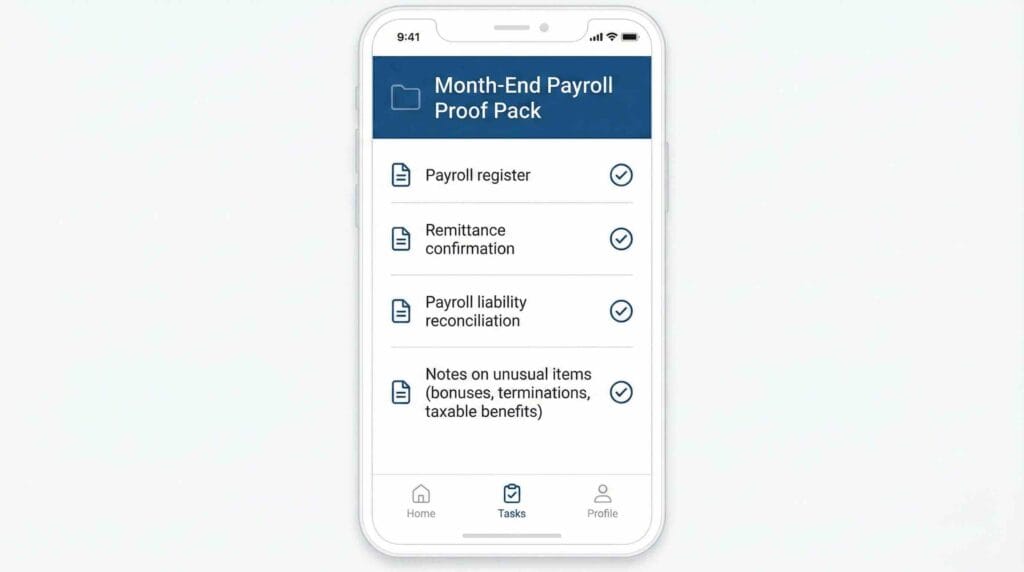
It’s not fancy. It’s consistent.
Typically it includes the payroll register, the remittance confirmation, a reconciliation of payroll liability accounts, and notes on any unusual items (bonuses, terminations, retro pay, taxable benefits).
If your month-end close feels heavy, it’s often because payroll is not close-ready. If you want a broader framework, you can tie this into your financial close process using your existing approach from Month-End Close Checklist for Canadian Businesses (2026).
This is also where payroll outsourcing vs in-house Canada has a hidden advantage: many outsourced models can produce cleaner, consistent reporting, but only if your internal bookkeeping is aligned and you are not constantly patching past errors.
Cost comparison: how to evaluate outsourcing fees fairly
When you compare outsourcing quotes to in-house payroll, do not compare the quote to your payroll software subscription. That’s not the decision.
Instead, compare the quote to your true in-house cost model:
The payroll administrator’s time (including year-end).
Management time spent reviewing, correcting, and firefighting.
Software stack costs and add-ons.
The dollar cost and time cost of errors and rework.
The cost of key person risk, including training and backup coverage.
If you’re already experiencing payroll friction, you can treat it like a diagnostic signal. Payroll problems are rarely isolated. They often connect to time tracking issues, unclear approvals, and inconsistent documentation.
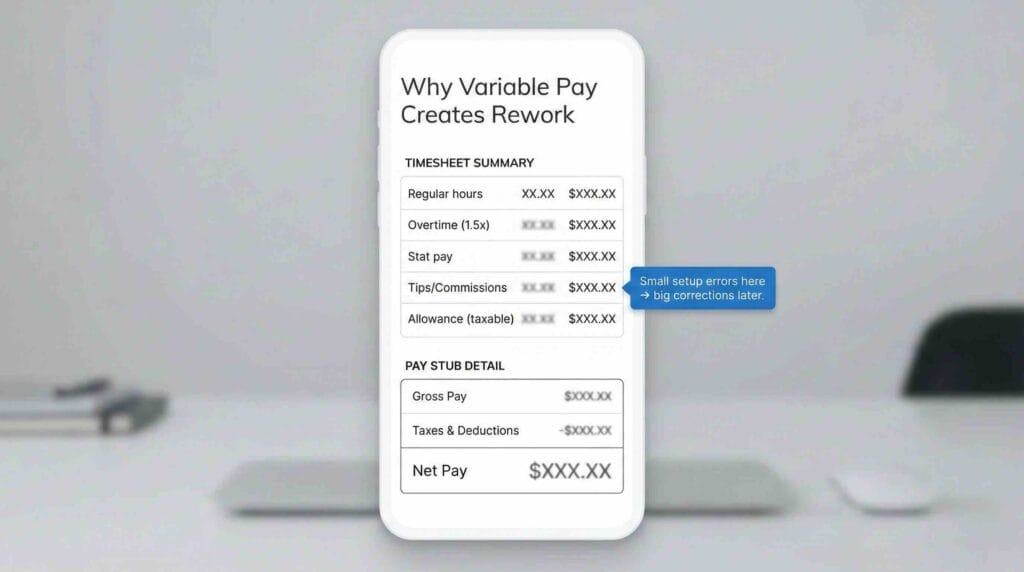
If you run tips, commissions, or variable pay, you already know how quickly payroll can get complicated. For BC employers in hospitality, the compliance side matters too, and it ties directly into setup and tracking. If tips and gratuities are part of your payroll mix, this is a useful reference point: Tips & Gratuities in BC Payroll: A 2026 Compliance Guide.
That’s one more reason payroll outsourcing vs in-house Canada is often about complexity management, not just cost.
Training a payroll backup
If you’re training a new payroll backup, CRA has practical employer resources on payroll deductions and remittances that can help your team get the basics right.
Decision checklist: when to keep in-house vs when to outsource
I’m going to keep this practical. Most businesses fall into a clear category once you look honestly at complexity and risk.
Keeping payroll in-house is usually a good fit when payroll is stable, variable pay is minimal, you have trained backup coverage, and your remittances and reconciliations are consistently clean. It also helps when you have strong internal process discipline and a manager who reviews payroll before it is finalized.
Outsourcing becomes more attractive when payroll complexity increases, turnover is high, variable pay is common, taxable benefits show up regularly, or when year-end has become stressful and error-prone. It’s also a strong move when you want better controls like approvals, audit trails, and separation of duties, but you do not want to build and maintain that entire system internally.
If you want a lens for risk, it’s worth reading your own history. Have you had corrections, amended slips, missed benefit tracking, or remittance stress in the last 12 months? If yes, that’s data, not bad luck.
A related read, especially if you’re thinking about risk and review discipline, is CRA Payroll Audit Red Flags: A 2026 Guide for Employers. Even if you never get audited, the red flags are basically a checklist for “what makes payroll messy.”
This is also the moment I remind clients that payroll outsourcing vs in-house Canada is not permanent. You can outsource now, stabilize processes and documentation, then decide later whether you want to bring some parts back in-house with stronger systems.
Implementation tips that prevent a painful transition
Whether you outsource or keep payroll internal, you’ll get better results if you do three things early.
First, document the workflow in plain language. Who sends hours, who approves, who enters, who reviews, who releases, and who files. If it’s not written down, it will break during vacations or turnover.
Second, align payroll with bookkeeping. Payroll should post to the correct accounts consistently. Liability accounts should reconcile. If they do not, month-end becomes guesswork. If you need a year-end perspective on what should be tidy and when, this is a good companion: Effective Year-End Payroll Checklist for BC Employers (2025 Edition).
Third, clean up historical issues before they grow legs. If you have remittance drift, inconsistent taxable benefit tracking, or unreconciled payroll liabilities, build a clean-up plan. Otherwise you’ll carry the mess into a new model and wonder why outsourcing did not “fix it.”
This is the practical heart of payroll outsourcing vs in-house Canada. A new provider can improve execution, but you still need clean inputs and clear approvals.
A practical way to decide without overthinking it
If you’re still stuck, try this simple approach.
Imagine your payroll lead is away for two weeks, starting tomorrow. Could your business run payroll accurately, on time, with clean remittances and documentation, without pulling an owner or director into emergency mode?
If the honest answer is no, you do not have a stable in-house payroll system yet. That doesn’t mean you must outsource, but it does mean you need either more internal structure or outside support.
And if you’re already losing time to payroll questions and corrections, that time is not free. It’s coming out of leadership attention, which is usually the scarcest resource in a growing Canadian business.
That’s why payroll outsourcing vs in-house Canada is best decided with a steady head and real numbers, not just a gut feel about software costs.
At Valley Business Centre, we’ve supported businesses across Metro Vancouver, Whistler, Squamish, and the Sea to Sky Corridor for more than 30 years with bookkeeping, payroll, tax preparation, and cloud accounting systems.
If you’re a BC employer in Vancouver, Surrey, Burnaby, Richmond, Coquitlam, or North Vancouver and you want payroll to run cleanly without last minute stress, reach out. We can help you tighten up tracking, reconcile deposits and payouts, and keep payroll and bookkeeping aligned so year end feels straightforward instead of stressful.
