

Year-end payroll BC 2026 can look simple on the surface: run the last payroll, print T4s, file, done. In real life, it tends to unravel in the same spots every year. Cutoffs get fuzzy, bonuses land on the wrong side of January, taxable benefits show up late, and payroll liabilities do not match what was actually remitted.
For BC employers, year end is also bigger than T4s. A clean close means your payroll system totals tie to your general ledger, your CRA payroll account makes sense, and the BC add-ons are not forgotten in the March rush.
We wrote this for owners, operations leaders, controllers, and office managers at small and mid-sized businesses who want year-end payroll BC 2026 to feel controlled, not chaotic.
Who this checklist is for and why year-end payroll goes sideways
If you touch payroll inputs, approvals, remittances, or the bookkeeping behind payroll, this checklist is for you. It applies whether payroll is run in-house, through a service, or through a hybrid setup where someone internally runs payroll and an external bookkeeper reviews and posts it.
Most year-end payroll problems are not “mystery accounting issues.” They are process issues that compound over 12 months.
Payroll is driven by pay dates, while your accounting often follows reporting periods. That difference is normal, but it creates timing gaps that show up at T4 time if you do not manage them intentionally. When we see payroll drift, it usually starts with something small: an adjustment posted to the wrong month, a manual cheque that never got posted properly, or a benefit that was coded as an expense but never treated as payroll income.
Taxable benefits are another big one. Benefits often live outside payroll, sitting in email threads, credit card statements, or a manager’s memory until someone asks, “Did we include the vehicle benefit this year?” By the time that question shows up, T4 totals may already be off and you are working backwards in February.
Finally, many teams do not do a full payroll-to-books tie-out until year end. When that happens, payroll liability accounts have usually drifted, and cleanup becomes a year-end payroll BC 2026 emergency instead of a routine check.
15 Essential Best Steps for year-end payroll BC 2026
Step 1: Confirm your last pay date of the calendar year.
Everything in year-end payroll BC 2026 starts with what was paid in the year. Lock in the final pay date that falls in the calendar year.
Step 2: Confirm your cutoff rule and document it in plain language.
If a pay period ends in December but you pay in January, decide how you will treat it and keep that rule consistent.
Step 3: Review bonus and commission timing before you process it.
If you want a bonus on the current year’s T4, it needs to be paid in the calendar year, not just approved in December.
Step 4: Check vacation payouts and year-end adjustments.
Vacation paid out at year end often runs off-cycle, which makes it easy to misclassify or miss in reconciliations.
Step 5: Review termination pay, retro pay, and other off-cycle items.
These payments create the most timing surprises, especially when they land in early January.
Step 6: Pull a year-to-date payroll register as of the last pay date.
This becomes your baseline for tying out totals before you generate slips.
Step 7: Tie gross wages to your general ledger wage expense.
If payroll totals and wage expenses do not match, identify whether it is allocation, posting, or timing before moving forward.
Step 8: Tie employer CPP and EI to the general ledger.
Employer portions can drift when payroll settings change mid-year or when manual adjustments are posted inconsistently.
Step 9: Reconcile source deductions payable (tax, CPP, EI).
After your last pay run, your payroll liability account should reflect what was withheld but not yet remitted.
Step 10: Reconcile vacation pay payable if you accrue it.
If vacation is accrued, year end is where you confirm the accrual matches policy and payroll records.
Step 11: Reconcile benefit-related payables if applicable.
If you remit benefits or withhold employee portions, make sure payables are supported and not carrying stale balances.
Step 12: Reconcile remittances to CRA by period and by remitter type.
Use CRA’s remittance cadence rules to confirm due dates and investigate any differences.
Step 13: Review taxable benefits and enter them before finalizing.
This is where most T4 amendments come from, so confirm the benefit list and values while the details are easy to verify.
Step 14: Run a draft T4 and review the common problem fields.
Check province of employment (Box 10), SINs, and benefit coding before you issue employee copies.
Step 15: Confirm BC add-ons and deadlines.
WorkSafeBC and Employer Health Tax are easy to miss if you treat year end as “just T4s.”
If you work through those 15 steps, the rest of year-end payroll BC 2026 becomes much more predictable. The sections below give you the context, the “why,” and the practical checks we use when we support employers through year end.
Year-end cutoffs in year-end payroll BC 2026 (where most mismatches start)
Before you reconcile anything, get your cutoffs clear and write them down. In year-end payroll BC 2026, the question you will answer repeatedly is: what was paid in the calendar year?
In most payroll situations, reporting follows the pay date. That means a pay period that ends in December but is paid in January usually belongs to the new year for payroll reporting. Once you anchor on that, a lot of the confusion disappears, and your conversations with your team become much simpler.
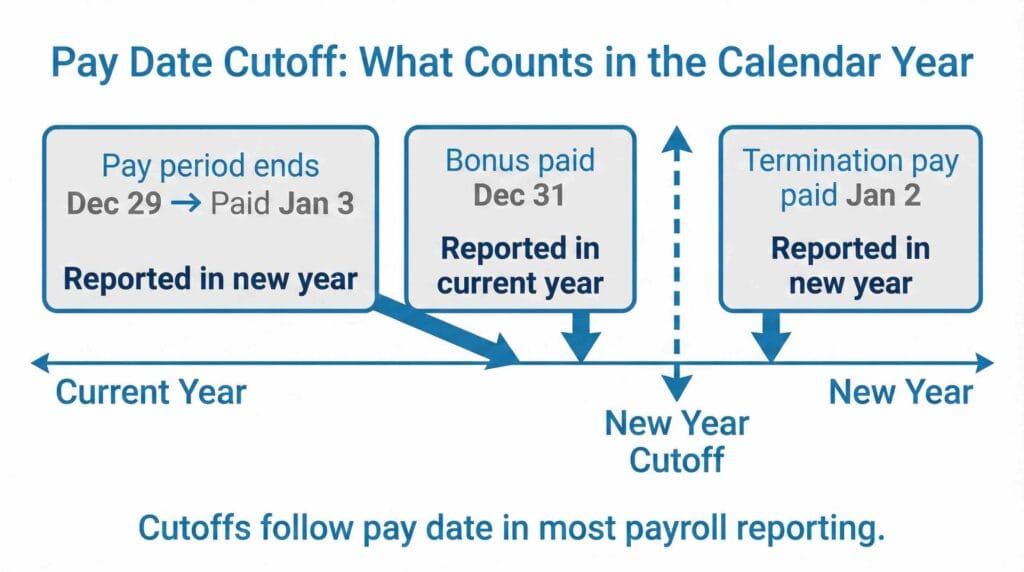
The situations that deserve extra attention are the ones that commonly break the tie between payroll reports and T4 totals.
Your last regular pay run of the year matters because it sets the boundary for your year-to-date payroll register. Confirm the pay date and keep it consistent with your reporting and your bookkeeping entries.
Bonuses and commissions are next. If you accrue them in the books but pay them after year end, your financial statements and your payroll reporting can legitimately land in different years. The key is to document it so you do not chase a “difference” that is actually expected.
Vacation payouts, retro pay, and termination pay often run off-cycle and can be approved quickly when operations are busy. The pay date still matters, and so does your internal documentation, especially if the payment relates to an interruption of earnings.
Seasonal shutdowns can also create confusion. If there are periods with no payroll, do not assume there is nothing to do. CRA remittance rules depend on remitter type and cadence, and CRA’s guidance on when to remit source deductions is the right place to confirm what applies to your situation.
A simple habit helps here: save a one-page “year-end cutoff note” with your payroll file. When someone asks in March why a December period is missing from the T4, you can point to the pay date rule and the last pay date you used, without trying to reconstruct the logic under pressure.
Year-end payroll BC 2026 cutoff check (quick sanity test)
If you want a quick signal before you go deeper, run a year-to-date payroll register as of the last pay date in December and compare it to the year-to-date payroll expense in your general ledger.
Small differences can be timing. A large gap usually means one of three things: a cutoff issue, a posting issue, or a benefit that was booked but never run through payroll. Catching this early is one of the easiest wins in year-end payroll BC 2026.
Reconciliation steps that make year-end payroll finance-grade
A “T4-ready” payroll file in year-end payroll BC 2026 is not just accurate inside the payroll system. It also ties to your bookkeeping and aligns with what CRA shows on your payroll account.
We recommend thinking about reconciliation as a three-way tie: payroll reports, general ledger, and CRA payroll account. If one corner is off, you usually discover it when T4s do not match expectations or when your payroll liability account refuses to clear.

Start by tying payroll reports to the general ledger. Pull totals for gross wages, employer CPP, employer EI, taxable benefits (if they are processed through payroll), and any other employer payroll costs you track. Then compare them to your wage and payroll tax expense accounts. If you allocate wages by department, job, or location, confirm those allocations did not change mid-year without a matching update in your bookkeeping rules.
Next, reconcile payroll liability accounts. At minimum, confirm your balances for source deductions payable (income tax, CPP, EI). If you accrue vacation pay, confirm vacation pay payable is supported. If you have benefit programs with employee and employer shares, confirm any benefit-related payables are reasonable and match what was actually withheld or owed.
Then reconcile remittances. Compare what your payroll system says you withheld to what you actually remitted, period by period. When something is off, do not jump straight to an adjustment. Look for timing differences, late remittances, corrections, and manual cheques that were processed differently than your standard runs.
If you want a structured way to make this routine, it helps to treat payroll like part of the monthly close, not a separate admin task. Many teams build payroll checks into their close process using a framework like our Month-End Close Checklist for Canadian Businesses (2026). The payoff is that year-end payroll BC 2026 becomes a controlled close, not a scramble.
One more practical point: if your business has grown, higher payroll volume increases the chance of small errors getting buried. In those cases, it helps to know what CRA tends to focus on and tighten documentation in advance. Our overview on CRA Payroll Audit Red Flags: A 2026 Guide for Employers is a helpful cross-check for common weak spots.
Taxable benefits in year-end payroll BC 2026 (the silent T4 breaker)
Taxable benefits are one of the most common reasons year-end payroll BC 2026 turns into rework. It is rarely because someone did something wrong on purpose. It is because benefits are easy to miss when they are not part of the regular payroll workflow.
CRA’s Employers’ Guide to Taxable Benefits and Allowances is the most practical reference point because it breaks down common benefit types and how to treat them.

In BC, the benefits we most often see causing year-end surprises include employer-provided vehicles, employer-paid parking, gift cards and awards programs, group term life premiums, tool allowances in trades, and meals or per diems that are not supported by policy.
Vehicle benefits deserve special attention because the calculations and documentation matter. If an employer-provided vehicle is in the mix, CRA’s guidance on automobile and motor vehicle benefits is worth reviewing early, not at the end.
The bookkeeping angle matters here too. Some benefits start as expenses on a corporate card, then get coded as staff meals or vehicle expenses, and never get evaluated for payroll reporting. Year-end payroll BC 2026 goes smoother when you decide early: is this a reimbursement supported by receipts and a clear business purpose, or is it a taxable benefit that needs to be valued and included?
If you have tipped staff, your treatment of tips and gratuities also needs to be consistent and well documented, because it affects payroll reporting and source deductions. If you want a BC-specific cross-check, see our Tips & Gratuities in BC Payroll: A 2026 Compliance Guide.
A good way to reduce benefit surprises is a monthly benefits review. It does not need to be complex. We typically suggest reviewing corporate card activity for employee-related costs, confirming what should be reimbursed versus reported, and ensuring anything taxable is captured while the details are still easy to confirm.
Payroll liabilities and remittance review (avoid interest and cleanup later)
Once payroll ties to the books, shift to the compliance side of year-end payroll BC 2026. This is where small timing issues can turn into interest or confusing account balances.
First, confirm your remitter type and cadence. CRA remittance schedules can be monthly, quarterly, or accelerated, and due dates differ. If your business has grown or cash flow has changed, it is common for remitter status to shift over time, so it is worth confirming you are operating on the right schedule using CRA’s guidance on when to remit source deductions.
Second, confirm payments were not just made, but applied correctly. It is possible to pay on time and still see a messy CRA account if a payment was applied to a different period than expected. When that happens, the CRA account balance can look wrong even if cash left the bank on time.
Third, look at your payroll liability balances right after the last pay run of the year. In many businesses, the liability balance at year end should reflect the deductions withheld but not yet remitted. If the balance feels too high or too low, treat it as a signal that something needs review before T4s are produced.
If you are finding that payroll issues keep resurfacing every year, it may be time to adjust how payroll is managed. Some employers stay in-house but add an external review step. Others outsource fully to reduce admin strain and improve consistency. If you are weighing that decision, our Payroll outsourcing vs in-house Canada: a 2026 cost guide for employers lays out the trade-offs in practical terms, including where hidden admin time tends to show up.
T4 readiness and common mistakes (2026 edition)
Most employers start thinking about T4s too late. The businesses that handle year-end payroll BC 2026 well usually treat T4s as the last step, not the first step. They reconcile first, run a draft, review, then finalize.
CRA confirms T4 filing and delivery expectations in its Employers’ Guide to filing the T4 slip and summary. For the 2025 calendar year, CRA lists the T4 filing due date as March 2, 2026, and employers must provide T4 slips to employees by the last day of February.

From a practical standpoint, the goal is to avoid corrections after slips go out. Here are the mistakes that most often create amendments, employee frustration, and extra admin work.
Province of employment (Box 10) is one of the biggest. With remote work and multi-location teams, the province is not always “where the person lives.” It is often tied to the employer’s establishment they report to. If your workforce moved around during the year, build a review step into your year-end payroll BC 2026 process so you are not correcting this after the fact.
Missing or incorrect SINs are another common issue. CRA expects reasonable efforts to obtain and verify SINs, and missing information can create compliance and penalty concerns. The fix is not complicated, but it does require a disciplined intake process when you hire.
Taxable benefits are the repeat offender. If benefits are identified late, you can end up re-running T4s, reissuing slips, and answering avoidable questions from employees and managers.
When you are ready to finalize, run a draft T4, compare it to your year-to-date payroll register, and cross-check totals against your wage expense and liability accounts. That extra loop is where most year-end payroll BC 2026 problems get caught before they become filed errors.
BC add-ons employers forget: Employer Health Tax and WorkSafeBC
BC employers often have two year-end items that sit outside the T4 process, which is exactly why they get missed.
Employer Health Tax (EHT) is one. If you are subject to EHT, confirm whether you need to file and make final payment by March 31, 2026 for the 2025 calendar year, and confirm thresholds and requirements with the Province’s BC Employer Health Tax overview.
WorkSafeBC annual reporting is the other. Many employers need to complete an annual payroll reconciliation and confirm assessable payroll and classification. WorkSafeBC publishes deadlines and reporting guidance on its WorkSafeBC dates and deadlines page.
If you plan year-end payroll BC 2026 with these in mind, you avoid the March pile-up where T4s, EHT, and WorkSafeBC all compete for the same limited admin time.
System and process checks that make next year easier
Most businesses treat year-end payroll BC 2026 as a once-a-year project, but the stress usually comes from small gaps that were present all year. The fix is not a more complicated year-end checklist. It is a clearer monthly routine.
Inputs matter. Who submits changes, how they are approved, and how you document adjustments will determine whether payroll stays clean. Even a short written process can reduce “we thought someone else handled that” errors, especially when there are multiple approvers or managers in the mix.
Integration matters too. Time tracking, scheduling, job costing, and payroll have to hand off cleanly, or you will keep seeing retro pay, corrections, and off-cycle runs that complicate year end. If you are building that workflow out, our guide on Time Tracking + Payroll Integration in 2026: A Setup Guide for Canadian Businesses walks through practical setup considerations that reduce manual rework.
When you tighten those two areas, year-end payroll BC 2026 becomes a confirmation exercise. You still do the work, but you stop doing emergency cleanup.
How to use this checklist without adding busywork
The point of year-end payroll BC 2026 is not to create paperwork. It is to finish with confidence that your payroll reports match your books, your remittances make sense, and your employees receive accurate slips on time.
If you want the highest-impact approach, focus on three things: lock your pay-date cutoffs, reconcile payroll to the books and the CRA payroll account before you touch T4s, and confirm taxable benefits while the details are still easy to gather. When those three are in place, the rest of the checklist becomes a structured wrap-up instead of a fire drill.
At Valley Business Centre, we’ve supported businesses across Metro Vancouver, Whistler, Squamish, and the Sea to Sky Corridor for more than 30 years with bookkeeping, payroll, tax preparation, and cloud accounting systems.
If you’re a BC employer in Vancouver, Surrey, Burnaby, Richmond, Coquitlam, or North Vancouver and you want year-end payroll BC 2026 to wrap up cleanly without last minute stress, reach out. We can help you tighten up tracking, reconcile deposits and payouts, and keep documentation organized so the season feels manageable instead of messy.
