
The expense policy small business teams can actually follow is the difference between a smooth month end and a constant drip of “Can you resend that receipt?” messages.
Most reimbursement processes start out harmless. Someone buys parking, snaps a photo, and finance pays them back. In a very small team, that approach can limp along for a while. The trouble is it does not scale. Once you hit 10 to 20 employees, add job sites or client work, and introduce a few managers who approve differently, the same simple process turns into delays, disputes, and messy bookkeeping.
The dollars are rarely the biggest problem. Time is. When finance has to chase missing receipts, decode vague descriptions, and fix coding after the fact, month end slows down and reporting becomes less reliable. A practical expense policy plus a receipts workflow solves this in a way that feels fair to employees and workable for managers, while keeping your books clean in QuickBooks Online.
We wrote this for Canadian small and mid sized businesses that want something realistic. Not a long policy nobody reads, and not a loose “use your judgement” system that creates inconsistent approvals.
Expense policy small business: why reimbursements go sideways as teams grow
Reimbursement chaos usually comes from dozens of small inconsistencies rather than one big mistake. Early on, the “system” is a patchwork of emails, texts, spreadsheets, and receipt photos in a shared folder. People submit different levels of detail, managers approve with limited context, and finance tries to stitch everything together later.
Here is what we see most often when the volume picks up. One person gets reimbursed for a meal with a card slip, another gets rejected because they did not include an itemized receipt. Someone logs mileage as a round number every week with no job reference. A tool purchase lands in the wrong expense category because nobody knows whether it counts as supplies or equipment. All of that creates friction, but it also creates risk because your audit trail becomes thin.
The goal of an expense policy small business leaders should aim for is not to make claims harder. It is to make them predictable. Predictable for employees who want to get paid back quickly, predictable for managers who need a clear standard, and predictable for bookkeeping so coding and tax treatment are consistent.
When the workflow is set up properly, you get speed, fairness, compliance, and clean books. That is the whole point.
What to standardize first so you cut 80% of disputes
Most businesses do not need to standardize every category on day one. It is smarter to start where the arguments and rework happen. In Canada, that typically means meals, mileage, tools, and home office style claims.
A simple approach that works well is a one page “rules table” plus a short exceptions process. Your expense policy small business version should be short enough that managers actually reference it, and clear enough that employees can submit a compliant claim without guessing.
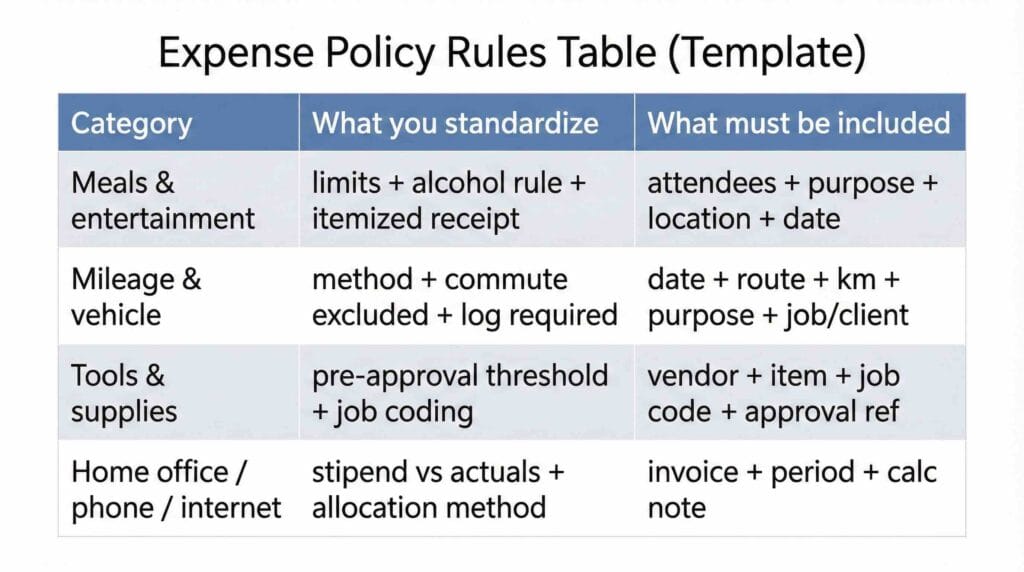
At a high level, your standards should answer two questions for every category. What counts as reimbursable, and what must be included to support it. If you want a tax anchor for meals, CRA’s guidance on Line 8523 meals and entertainment (allowable part) is a useful reference point, especially because meals often have limitations for income tax purposes and require stronger documentation.
A practical expense policy small business owners put in place should reduce judgement calls. Less judgement means fewer disputes and less back and forth at month end.
Meals and entertainment: get clear on “why” and “who”
Meals are a magnet for confusion because they sit between three buckets: business development, staff morale, and personal spending. If the policy does not draw clean lines, managers end up approving based on personal preference, and finance gets stuck arbitrating.
Start by defining what counts as a business meal versus a staff meal. Decide whether client entertainment needs a higher approval threshold. Then settle the alcohol rule. Some businesses allow it with a cap and a clear business purpose. Others make it non reimbursable. Either approach can work, but only if it is consistent and communicated.
Receipt rules matter here because the details drive defensibility. For meals, we generally recommend requiring an itemized receipt so the purchase is clear. A credit card slip alone often leads to questions later, especially if the memo does not explain who attended and why the meeting happened.
If you want your expense policy small business workflow to feel fair, focus on the basics: itemized receipt, attendees, business purpose, location, and date. When those five elements are always there, approvals become faster and bookkeeping becomes easier.
Mileage and vehicle: choose one method and document it
Mileage is one of the easiest places for leakage, even when nobody is being dishonest. When people estimate, round up, or mix reimbursement methods, costs drift upward and the logs become hard to trust.
Pick one approach and stick to it: mileage reimbursement per kilometre, company paid vehicle costs, or a vehicle allowance. Then define what counts as business travel, explicitly exclude commuting, and require a simple mileage log that includes date, route, kilometres, purpose, and a job or client reference.
For Canadian employers, CRA’s guidance on automobile and motor vehicle allowances is worth reviewing because it affects whether an allowance is taxable and what “reasonable” means in practice.
If you already have a mileage issue, it often ties back to job tracking. Trades and field service teams usually benefit from job level coding so mileage and tools land where they belong. Our guide on Job Costing in QuickBooks goes deeper on that setup.
A well written expense policy small business teams use will make mileage feel boring. Boring is good. It means the process is working.
Tools, equipment, and supplies: stop the “is this a tool or an asset?” argument
Tools and supplies create confusion because some items are consumables, some are durable tools, and some edge into capital assets. Without thresholds, employees buy what they need, managers approve it, and finance later has to decide where it belongs and whether anything should be tracked differently.
Set clear thresholds that match your business. For example, you might allow routine consumables under a set amount with no pre approval, require pre approval above that level, and treat higher value items as potential assets depending on your accounting policy. Also decide whether you want an approved vendor list for common purchases, which can reduce random merchants and make receipts more consistent.
If tools are billable to a job, require job or project coding at submission. That one rule can protect your margins because it keeps costs aligned with revenue. If you are thinking about scaling controls without adding admin work, our post on Bookkeeping Automation in 2026 pairs nicely with a standardized tools policy.
A strong expense policy small business version keeps tools simple for employees, while giving finance enough structure to code correctly.
Home office, phone, and internet: choose a model that managers can enforce
This category is where businesses accidentally write a policy that is too complicated to run. If a manager cannot apply the rule in real time, approvals become inconsistent and finance ends up cleaning it up later.
Decide the model first. You can use a stipend or allowance, or you can reimburse actual costs based on invoices. A stipend is often simpler operationally. Reimbursing actuals can be more precise, but only if you define what is reimbursable, how allocation works, and what is out of scope.
If you reimburse actuals, standardize what proof is required, what period the invoice covers, and how employees note the business portion. The goal is not to create perfect math. The goal is to create a consistent standard that managers can approve and finance can code.
Your expense policy small business approach should favour clarity over perfection, especially in categories that otherwise become a monthly debate.
Approval workflow and documentation rules that actually work
Even the best policy fails if the workflow is unclear. Employees submit too little information, managers approve with a quick glance, and bookkeeping tries to fix it later. That is how the month-end becomes stressful and reporting becomes unreliable.
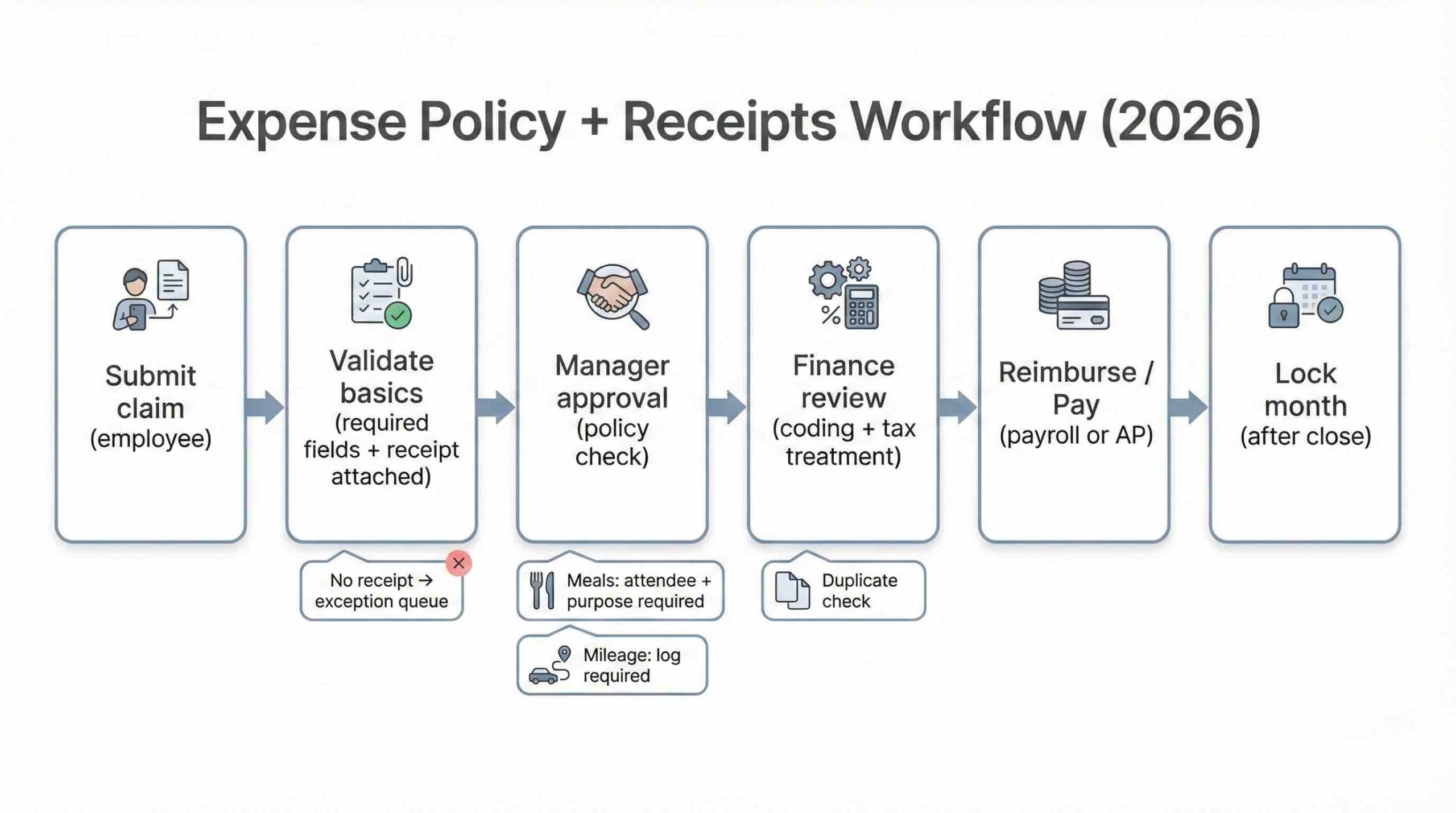
A scalable workflow is straightforward: employees submit, the system validates the basics, managers approve, finance reviews for policy compliance and coding, payment runs, and the period is locked after closing. If you want the month-end to run tighter, linking your reimbursement workflow to your close process helps. Our post on Month-End Close Checklist for Canadian Businesses (2026) outlines how to keep expense cleanup from dragging the close.
Building an expense policy small business teams will actually use
This is where you keep it practical. Spell out roles in plain language and keep the approval structure simple.
Employees are responsible for submitting complete claims with receipts and a business purpose. Managers are responsible for approving reasonableness and policy fit. Finance is responsible for final review, coding, and tax treatment so the books stay consistent.
Then set approval thresholds based on your risk and your volume. Many businesses streamline smaller claims when the receipt and required fields are present, require manager approval above a set level, and require a second approval above a higher level or for exceptions. This is not about bureaucracy. It is about consistency. When thresholds are clear, managers do not have to invent rules, and employees do not feel like approvals are personal.
A clear expense policy and small business workflow also prevents the quiet problems, like a missing receipt becoming “normal,” or a tool purchase being approved without any job reference.
Documentation rules: what “good” looks like
If you want reimbursements to move quickly, define minimum fields and enforce them. At a minimum, a claim should include date, vendor, amount, business purpose, and category. If you track jobs, projects, or customers, include that reference at submission so it does not get lost later.
Receipt standards should match the category. Meals usually require itemized receipts. Tools need vendor and item detail. Mileage needs the log entry. Then add timing expectations: submit within a set number of days, approve within a set number of days. Without timing, people submit a pile of old receipts at once, and your books stop matching what happened in the month.
CRA’s guidance on keeping records is a good reminder that documentation is not just a preference. It supports the deductions and the tax positions you take.
When your expense policy small business system makes complete submissions the default, finance spends less time chasing and more time producing useful reporting.
Exceptions process: keep it rare, not impossible
Real life happens. Receipts get lost, especially for people travelling or working between sites. You still need an exception process, but it should be controlled and designed to stay rare.
A common approach is a missing receipt declaration that requires a written explanation, manager approval, and a per claim cap. Many businesses also cap how often an employee can use the exception in a period. That keeps the policy human without turning “missing receipt” into a habit.
If missing receipts become frequent, treat it as a process problem first. Often the submission tool is clunky, employees do not know what is required, or managers are approving without pushing back.
How to implement this in QuickBooks Online without overengineering it
QuickBooks Online can support a clean workflow, but only if the inputs are consistent. The tech is not the hard part. The habit is.
If your team is actively comparing platforms, our breakdown of QBO vs Xero Canada (2026) may help you think through approvals, reporting, and how attachments and tracking are handled.
Set up categories that match your policy language
Start with your Chart of Accounts and build categories that reflect how you want people to think. For many businesses, that means separate buckets for meals, mileage reimbursement, tools and small equipment, office supplies, cell phone and internet reimbursement, and travel.
Naming matters more than people expect. “Policy friendly” names reduce miscoding because they give the submitter and the approver a hint. For example, “Meals, client, notes required” or “Tools under $X, job code required” can reduce guesswork.
If you track by department or location, QBO Classes or Locations can help. If you track by customer, job, or project, use Projects or Customer tracking. The point is to make allocation easy without creating admin work.
A consistent expense policy small business setup depends on consistent categories, because categories drive reporting, review, and tax treatment.
Require memos and attach receipts every time
Make the rule explicit: no receipt, no reimbursement, except through the controlled exception process. When employees know the standard, they usually comply. When the standard is fuzzy, finance pays the price later.
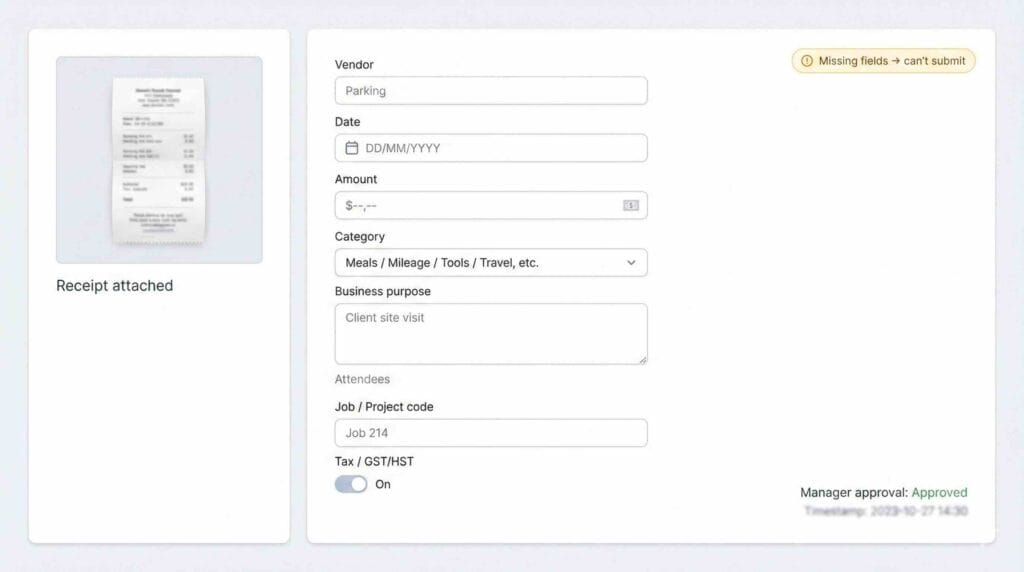
In QBO, attach receipts directly to the transaction whenever possible and adopt a memo standard that captures the business purpose. If meals are involved, include attendees. If the cost is job related, include the job number. If it was pre approved, note who approved it. For QuickBooks guidance written for users, enter and manage expenses in QuickBooks Online is a good starting point, and then you tailor the habit to your policy.
This is one of the fastest ways an expense policy small business team can improve audit readiness without adding extra cleanup later.
Choose one reimbursement payment path and stick to it
You generally have two clean options: reimburse through payroll for employees, or reimburse through accounts payable, especially for contractors. Payroll reimbursement can be smooth because it aligns with employee records and creates a predictable cadence. A/P reimbursement can work well if you want approvals tied to bill payment processes.
The key control is not the method. It is consistent. When companies mix methods without a rule, duplicates happen. Someone buys something on a company card, then submits it as a reimbursement, and nobody catches it until later.
If your payroll and time systems are connected, you can reduce manual work further and keep records aligned. Our post on Time Tracking + Payroll Integration in 2026 explains how to connect the dots in a practical way.
An expense policy small business system should tell people exactly where reimbursements show up and when, so employees trust the process and finance avoids duplicates.
Monthly controls in QBO that prevent quiet leakage
Set a recurring monthly review and keep it lightweight. Review uncategorized expenses, reimbursements without attachments, and spikes by employee, vendor, or category. Then spot check a few items from the top of the list. Finally, lock the month after close so approved expenses are not edited quietly.
This is also where KPIs help. If reimbursements are growing, treat that as a measurable line item rather than a feeling. Our post on 5 KPIs Every Canadian Business Should Track Monthly (2026) includes metrics that make expense creep visible without turning finance into the police.
A mature expense policy small business program includes a monthly check, not just a policy document.
Fraud and leakage warning signs you should not ignore
Most reimbursement problems are not dramatic fraud. They are slow leakage. That leakage shows up as repeated exceptions, vague memos, and approvals that happen too quickly.
Watch for patterns like repeated missing receipt claims, especially just under an approval threshold. Round dollar meals or mileage claims can be a clue that people are estimating rather than recording. Weekend or holiday expenses without notes deserve a quick question. Duplicates can happen when the same receipt is submitted twice, or when an item is reimbursed and also paid on a company card. Also keep an eye on unusual merchants that repeat for one employee, especially when the category is vague.
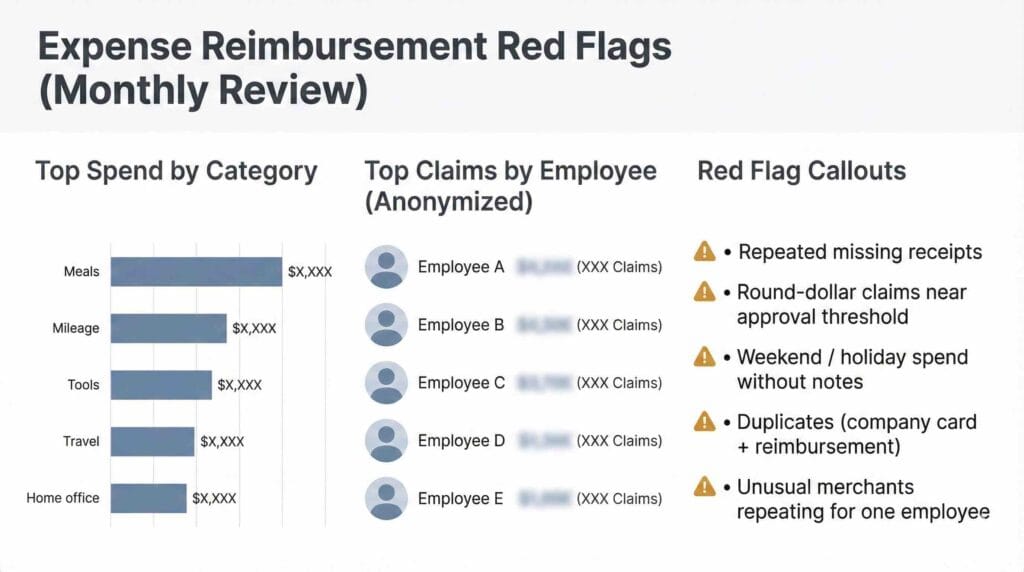
Approval behaviour matters too. If a manager approves everything instantly with no questions, the control is not working. Managers do not need to be auditors, but they do need to apply the policy consistently.
If you want a deeper control-focused read, our older post on Defending Your Company against Expense Reimbursement Fraud complements the workflow approach here.
A good expense policy small business system is designed to prevent problems early, not just detect them after month end.
30 day rollout plan so it actually gets adopted
The best policy in the world fails if rollout is sloppy. Aim for fast implementation and quick feedback, especially in the first month when habits form.
In week one, draft your one page rules table, approval thresholds, and exception process. Then test it with one manager and one employee and listen carefully to what feels unclear. That feedback will save you weeks of friction later.
In week two, configure QBO categories, tracking choices, and memo standards so your bookkeeping team can code consistently. Keep it minimal. Complexity feels impressive, but it often reduces adoption.
In week three, train managers on what they are responsible for approving and what must be pushed back. If managers are not aligned, employees will quickly learn to route claims to the most lenient approver.
In week four, go live and run your first monthly review. Fix friction points quickly. If employees struggle with attachments, simplify submission. If categories are confusing, rename them. Your expense policy small business process should be firm on documentation but flexible on improving how people comply.
Practical examples that reduce disputes immediately
If you want quick wins, focus on the conversations that create the most back and forth.
For meals, replace “reasonable meals are reimbursable” with a clear requirement: itemized receipt, attendees, and purpose. Once managers know what to look for, approvals become consistent.
For mileage, do not approve based on totals alone. Require the log and a job reference. If someone makes the same route weekly, that can be legitimate, but it should tie back to a client or site.
For tools, stop surprises by requiring pre approval above a threshold and requiring job codes for billable purchases. That keeps the expense aligned with the work and avoids margin confusion later.
For home office claims, choose a stipend or a defined allocation method with a limit. The simpler the rule, the more consistently it gets applied.
These examples all point to the same thing. An expense policy small business team can live with removes ambiguity and reduces judgement calls.
Where this ties into tax and compliance in Canada
Your policy is operational, but it supports tax compliance. Good documentation supports your ability to deduct expenses and, where applicable, support GST/HST input tax credits. Consistent categorization reduces errors, and consistent reimbursement methods reduce the risk of duplicates and payroll reporting confusion.
If you use allowances, make sure you understand when they are taxable versus non taxable, especially for vehicle-related allowances. CRA guidance on automobile allowances is the best starting point, and your accountant can confirm how it applies to your specific structure.
If you want a related read on compliance signals that trigger reviews, our post on CRA Payroll Audit Red Flags is helpful context for why clean documentation and consistent processes matter.
A well implemented expense policy small business workflow is not about fear. It is about reducing rework, reducing disputes, and keeping your books defensible.
Final checklist to sanity check your workflow
Before you roll this out, ask a few practical questions. Can an employee submit a complete claim in two minutes? Can a manager approve in under a minute because the information is standardized? Can bookkeeping code it without guessing? And can you find the receipt attached to the transaction six months later without digging through emails?
If the answer is yes, you are in good shape. If the answer is no, the fix is usually simple: clarify categories, tighten the receipt standard, or define approval roles more clearly.
When your expense policy small business process is clear, reimbursement stops being a monthly fire drill and becomes a routine system you barely notice.
At Valley Business Centre, we’ve supported businesses across Metro Vancouver, Whistler, Squamish, and the Sea to Sky Corridor for more than 30 years with bookkeeping, payroll, tax preparation, and cloud accounting systems.
If you’re a BC business with employees or managers in Vancouver, Surrey, Burnaby, Richmond, Coquitlam, or North Vancouver and you want reimbursements to run faster with cleaner records, reach out. We can help you tighten up tracking, reconcile deposits and payouts, and keep documentation organized so month end feels straightforward instead of stressful.
