

Loan readiness clean books Canada is no longer just “nice to have” if you want financing in 2026. It’s the difference between a straightforward approval process and weeks of follow-up questions that slow everything down, even when your business is performing well.
What’s changed is the pace and the level of verification. Whether you’re applying through a bank, a credit union, BDC, or an alternative lender that connects to your accounting platform, underwriting teams want the same thing: numbers they can trust, reports that tie out, and a clear view of cash flow timing. When your books are clean, the lender can focus on your business story. When your books are messy, the conversation becomes a troubleshooting exercise.
We’ve structured this guide with clear headings so you can scan to the sections that match where you are in the process.
Why “fintech-ready” matters in 2026
Lending in Canada has moved from “paper package” to “data-first” in a lot of places, even when the lender is still very traditional. That doesn’t mean you’re giving a lender your login and walking away. It means decisions and requests are increasingly driven by structured reporting, consistent categorization, and reconciled accounts.
This is where loan readiness clean books Canada becomes practical, not theoretical. Connected systems can surface patterns quickly, like uneven margins, deposit activity that doesn’t match invoicing, or payables that are sitting outside the ledger. Those patterns trigger questions. Questions lead to extra documentation. Extra documentation can lead to delays, conditions, or pricing that feels harsher than it needs to be.
The good news is that you don’t need perfect books to be fintech-ready. You need lender-usable books: reconciled accounts, credible receivables and payables, clean liability tracking, and reporting that stays consistent from month to month.
What lenders and fintechs typically expect from Canadian businesses
Most lenders are asking for a familiar set of documents, but in 2026 they expect them to line up cleanly. It’s not enough to produce a P&L and hope for the best. Underwriters look for internal consistency, meaning your statements, subledgers, and schedules should agree with each other.
In Canada, you should plan for these core asks:
Your most current financial statements
That usually includes a year-to-date profit and loss and balance sheet, plus comparative periods. Lenders want trends, not only a snapshot.
A/R and A/P detail
Expect accounts receivable aging and accounts payable aging, with questions about older balances, credits, and concentrations.
A clear list of debt and lease obligations
A debt schedule is almost always requested, even if you think it’s “small.” We’ll walk through what it should include.
A near-term cash flow view
Many lenders want a forecast that shows how cash moves in the next few months and how payments will be covered. If you want a framework for projections that lenders recognize, BDC’s resource on financial projections is a good reference point for what a credible forecast looks like.
Program rules, if you’re applying under a specific program
Some lending programs in Canada have their own guidelines and eligibility constraints. For example, the Canada Small Business Financing Program guidelines outline what qualifies and what documentation is often required.
When we talk about loan readiness clean books Canada, we’re really talking about reducing the amount of “back-and-forth” required to validate these items. Lenders don’t mind asking questions. What they want to avoid is discovering that the numbers change every time they ask.
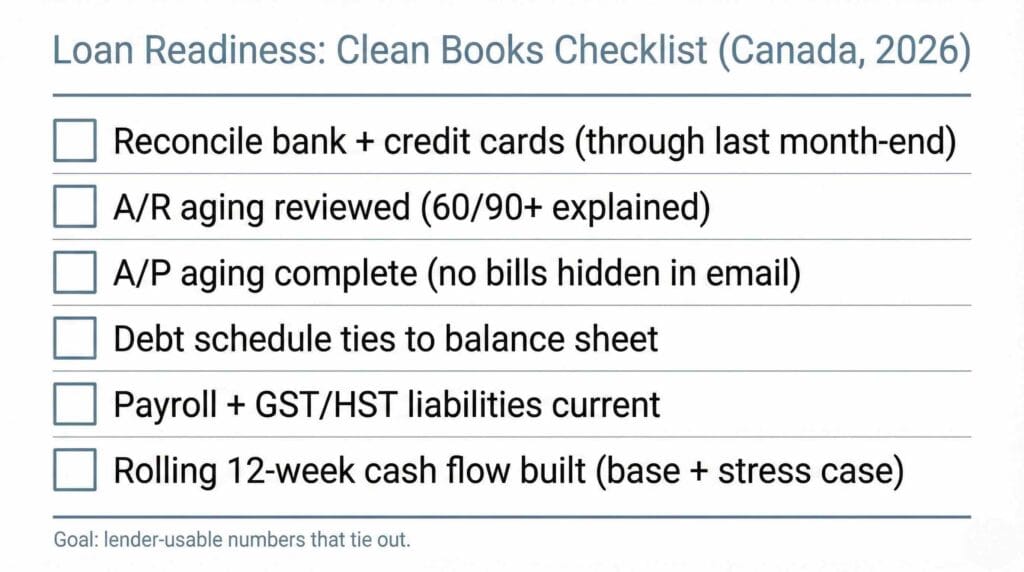
Loan readiness clean books Canada: the clean books checklist before you apply
A good way to think about this is pre-underwriting. You’re not polishing for appearances. You’re removing friction that slows down decisions and triggers extra scrutiny. When the basics tie out, your lender conversation becomes about capacity and terms, not about whether the reports are reliable.
1) Bank and credit card reconciliations are non-negotiable
If we could pick one priority before a loan application, it would be reconciliations.
Every bank and credit card account should be reconciled through the most recent month-end, ideally through last month-end if you’re applying mid-month. Reconciliations prove that revenue, expenses, and balances are grounded in actual transactions, not best guesses.
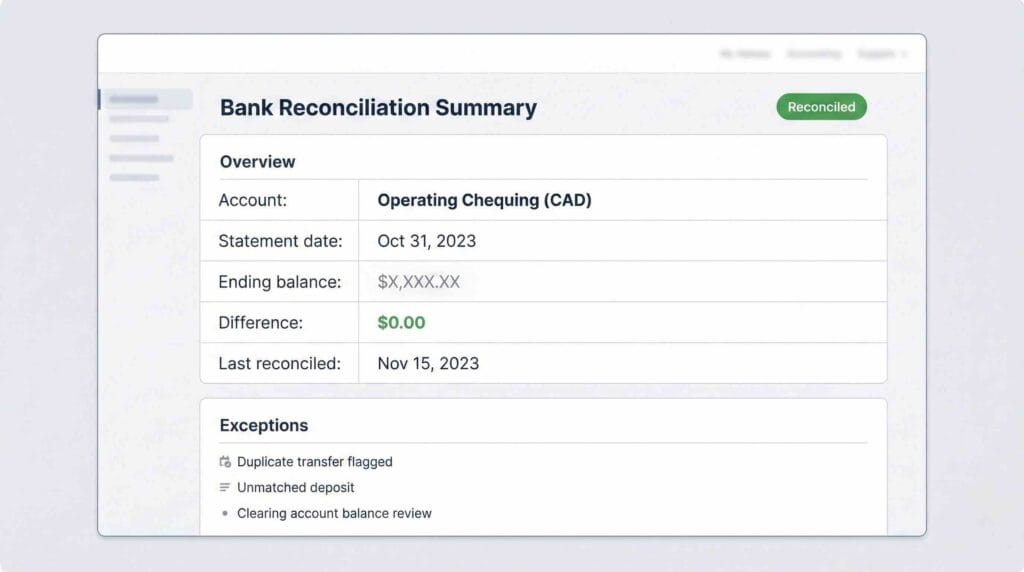
Where lenders start to worry is when reconciliation issues suggest the numbers might shift after review. The usual culprits are unexplained differences, suspense balances, transfers recorded twice, and clearing accounts that never clear. None of these are fatal on their own, but they create uncertainty, and uncertainty slows approvals.
This is also why a disciplined month-end close matters. When your close process is consistent, you can produce lender-ready reporting without scrambling. If you want a benchmark structure for your team, our post on Month-End Close Checklist for Canadian Businesses (2026) fits well with loan readiness clean books Canada because it focuses on repeatable routines, not one-time cleanup.
2) A/R accuracy proves your revenue converts into cash
Underwriters rarely take revenue at face value. They want to know whether revenue turns into cash, and how quickly. That’s why A/R is not just an accounting line. It’s a risk signal.
Start with your accounts receivable aging. Anything sitting in 60 days, 90 days, or older usually becomes a conversation. That doesn’t mean you’ll be declined. It means you should be ready to explain what’s collectible, what’s disputed, and what’s simply overdue.
We generally focus on three cleanups that make a noticeable difference in lender confidence. First, resolve old invoices with a documented plan, whether that’s collection steps, a negotiated payment plan, or a write-off decision. Second, fix misapplied payments and credits, because they create false aging and make your reporting look unreliable. Third, be ready to discuss customer concentration if one client represents a large share of revenue.
If you’re tightening collections as part of your financing story, it helps to show lenders you have a real process behind it. Our guide on Accounts Receivable Process: Get Paid Faster in 2026 Without Burning Relationships supports loan readiness clean books Canada because it links financial reporting to operational controls.
3) A/P accuracy shows your true near-term cash needs
Accounts payable is where we often see the biggest disconnect between “what the books say” and “what the business feels.” If bills are not entered consistently, your balance sheet looks stronger than reality and your cash flow forecast becomes unreliable. Lenders notice when payables suddenly jump during due diligence because bills were living in email rather than in the ledger.
The fix is straightforward but requires discipline. Bills should be entered when received, vendor credits should be matched properly, and your payable balances should reflect real obligations, not a mix of actual payables and future purchases that belong in the forecast instead. This is a core part of loan readiness clean books Canada because it prevents the surprise-liability problem that forces lenders to reassess repayment risk.
4) Build a debt schedule because lenders will ask anyway
A debt schedule is one of the simplest ways to look organized, and it saves time because lenders ask for it almost every time.
For each loan or lease, include the lender name, original amount, interest rate, payment amount, maturity date, current balance, and whether it’s secured or unsecured. If there are covenants, seasonal payment structures, or balloon features, add a plain-language note. Then tie the schedule total to your balance sheet so there’s no mismatch.
From a practical perspective, a debt schedule also helps you. It makes renewals easier, reduces missed maturity risk, and gives you a clearer view of how new borrowing fits into existing obligations. Done well, it supports loan readiness clean books Canada by making your liabilities easy to validate.
5) Clean chart of accounts and consistency month to month
In 2026, lenders will review ratios and trends faster than ever. If your chart of accounts is messy or categorization drifts month to month, your ratios become noise and your margins look unpredictable.
The cleanups that matter most are usually the simplest. Reduce or eliminate “Uncategorized”, “Misc.”, and “Ask My Accountant” style accounts. Separate owner transactions clearly from business operations. Keep cost of sales classification consistent so gross margin trends are meaningful.
If you’re reviewing systems because reporting feels harder than it should, our comparison post of QBO vs Xero Canada (2026): Which Fits Growing Teams? can help you decide what supports your workflows best. The software won’t fix the process on its own, but the right setup can make loan readiness clean books Canada much easier to maintain.
6) Tax and payroll liabilities should be boring
Lenders hate surprises, and nothing feels more “surprising” to an underwriter than undisclosed arrears or inconsistent remittance tracking. Payroll and sales tax liabilities should be accurate, current, and easy to reconcile.
At minimum, confirm payroll remittances are up to date and that the liability accounts in your books make sense. For GST/HST, ensure your GST/HST collected and input tax credits reconcile to filings. If anything is behind, it’s better to document a catch-up plan and show that it’s being followed than to leave it vague.
If you need authoritative reference points for compliance basics, CRA’s pages on GST/HST and payroll are the best starting point. This is a key part of loan readiness clean books Canada because lenders often treat compliance consistency as a proxy for operational discipline.
The 12-week cash flow underwriting teams actually use
A monthly forecast can be helpful for planning, but underwriting teams often want a near-term weekly view because it shows timing risk. In other words, they want to see whether cash is available on the weeks it needs to be available, not only “in the month.”
A rolling 12-week cash flow is one of the most lender-friendly tools you can build because it connects directly to payment timing. The format is similar to the widely used 13-week approach, and the concept is simple: build a weekly model around cash movement, then update it regularly as real results come in. If you want background on why this format is common in finance, Wall Street Prep’s explanation of the 13-week cash flow model is a useful overview.
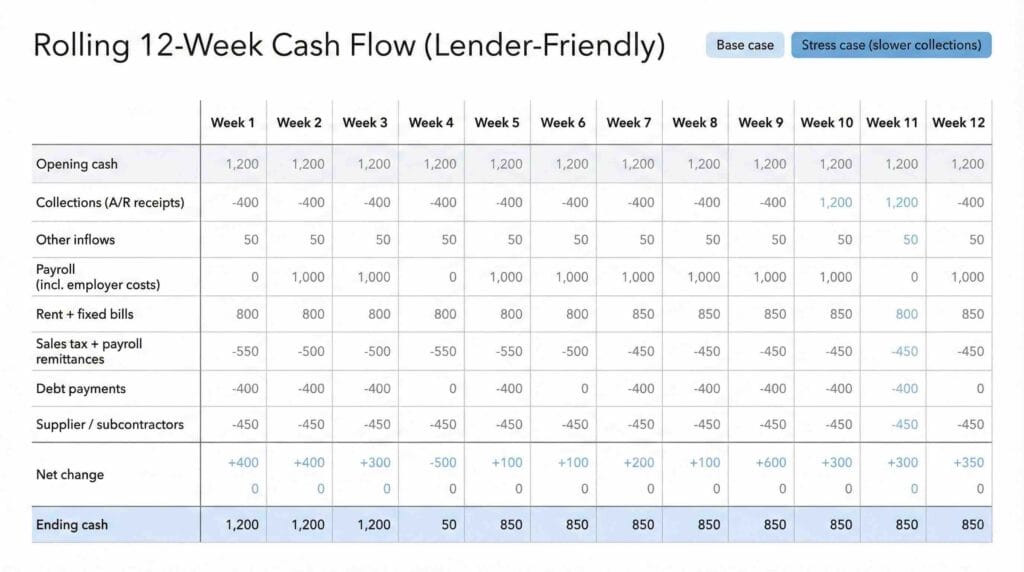
For loan readiness clean books Canada, the key is tying the forecast to real inputs rather than assumptions that feel optimistic in hindsight. Collections should flow from your A/R aging and expected customer behaviour. Payroll should be scheduled by actual pay dates and include employer costs. Rent, debt payments, and recurring subscriptions should be placed in the week cash actually leaves. Remittances should appear on the correct timing, not vaguely “somewhere later.” Inventory, subcontractors, and major suppliers should reflect known commitments and realistic purchasing plans.
We also recommend adding two scenarios: a base case that reflects your realistic plan, and a stress case where collections are slower or sales are slightly lower. You don’t need drama. You need a model that shows you understand timing risk and have thought through the impact.
If you want a deeper process and template approach, our guide on 12-Week Cash Flow Forecasting: A 2026 Playbook for Canadian Businesses ties in naturally with loan readiness clean books Canada because it helps you maintain the forecast as a living tool, not a one-off spreadsheet made for the lender.
Red flags that delay approvals or trigger extra scrutiny
A lender can like your business and still slow down the file if the data raises questions. The purpose of loan readiness clean books Canada is to remove avoidable red flags before they become the focus of the underwriting process.
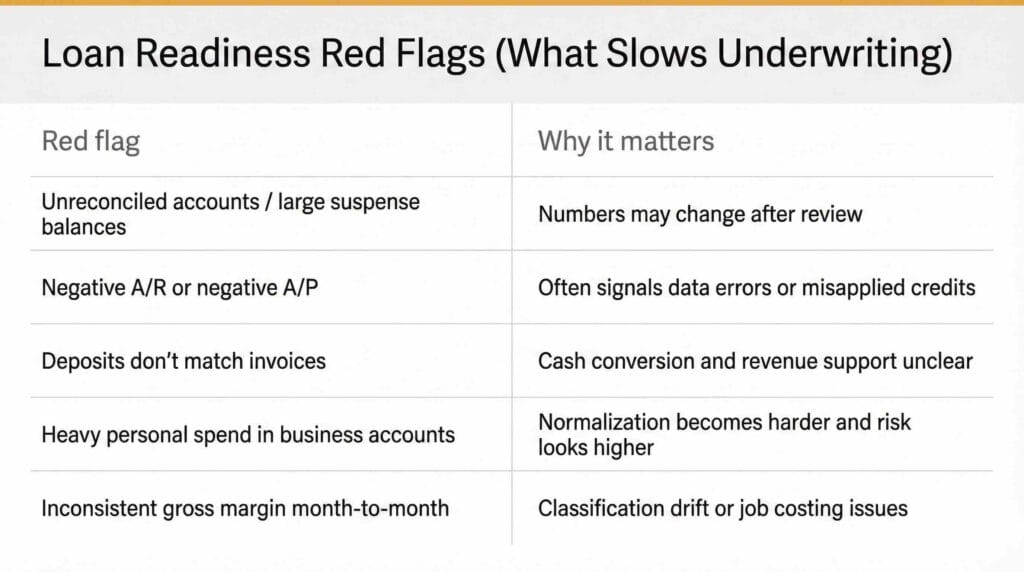
The most common friction points we see are unreconciled accounts, large suspense balances, and financial statements that don’t match the subledgers. We also see delays when revenue spikes without an operational explanation, when A/R or A/P shows negative balances due to misapplied payments or credits, and when personal spending runs heavily through business accounts.
Margin inconsistency is another big one. Sometimes it’s normal seasonality. Often, though, it’s classification drift, job costing issues, or costs being posted to the wrong period. Late remittances or tax arrears can also trigger extra conditions because lenders don’t want to step into a situation where CRA has priority claims.
Add-backs can be perfectly reasonable, but they need support. If you’re normalizing earnings by removing one-time expenses, document those items clearly so the lender isn’t guessing.
A simple “notes page” can do a lot of work here. When you explain anomalies in plain language, you reduce follow-up and show you understand your own numbers. That’s a subtle but meaningful part of loan readiness clean books Canada.
How to assemble a lender-ready package that gets through review faster
Once your books are clean, packaging matters. You’re making it easy for someone else to validate your story without chasing you for missing pieces.
A lender-ready package typically includes current financial statements with comparatives, A/R and A/P aging reports that match the balance sheet, a debt schedule that ties to the balance sheet, and a rolling 12-week cash flow with clear assumptions. Add a short notes page that explains any anomalies, seasonality, or one-time items, and you’ve removed a lot of friction from the process.
It also helps to provide a small amount of operational context when it’s relevant. If margins changed because you hired a senior role, note it and show the expected impact. If a large contract is front-loaded or back-loaded, explain the billing schedule and cash timing. When the numbers and the narrative match, underwriting becomes faster and less stressful.
This is where loan readiness clean books Canada becomes strategic. You’re not only producing documents. You’re reducing perceived risk and improving the quality of the financing conversation.
Practical timelines: what you can fix in 2 weeks, 6 weeks, and 90 days
Not every business can clean everything at once, especially if you’re also running operations. The trick is sequencing the work so you get to “lender-usable” quickly and then improve the foundation over time.
In the first couple of weeks, focus on the trust builders: reconcile bank and credit card accounts through the last month-end, clean up obvious coding issues, run accurate A/R and A/P aging, and build a basic debt schedule that ties to the balance sheet. This gets you most of the way toward loan readiness clean books Canada because it addresses the issues that trigger the most immediate lender questions.
Over the next six weeks, tighten the chart of accounts, resolve older A/R items with a clear plan, and make A/P completeness consistent. This is also a realistic window to build your first rolling 12-week cash flow and start updating it weekly so it reflects reality.
Over the next 90 days, the goal is to stop the clean-up cycle from repeating. That means tightening your month-end close, improving documentation workflows, and automating where it makes sense. If you’re looking for practical automation priorities that support lender-ready reporting, our post on Bookkeeping Automation in 2026: What Canadian Businesses Should Automate First is a good companion to loan readiness clean books Canada because it focuses on keeping the books clean going forward.
What to do before you hit “submit” on a loan application
Before you submit, do a final tie-out pass. This is the step that prevents last-minute surprises.
Confirm your bank balances match reconciliations and that there are no large unexplained differences. Confirm your A/R and A/P aging totals match the balance sheet. Confirm your debt schedule matches the balance sheet and reflects current balances. Confirm GST/HST and payroll liabilities align with filings and remittances. Then look at your 12-week cash flow and make sure it matches known commitments, including payroll dates, major supplier payments, remittances, and debt payments.
When you can answer “yes” across those tie-outs, you’re in a strong position. If the lender asks for a follow-up, you can respond quickly because your file is organized and your reporting is consistent. That’s the real benefit of loan readiness clean books Canada in 2026. It’s not only about approval. It’s about speed, control, and better financing terms.
Loan readiness clean books Canada in day-to-day operations
If your books are genuinely lender-ready, you’ll feel it in the way the business runs. Deposits match invoices without a scramble. Bills are entered when received, not weeks later. Payroll and sales tax liabilities don’t drift in the background. Month-end close becomes a routine process rather than a seasonal cleanup. Most importantly, when you need a report for a lender, an investor, or even internal decision-making, you can produce it confidently.
How loan readiness clean books Canada shows up in your reporting rhythm
A practical test is this: if someone asked you today for a current balance sheet, an A/R aging, an A/P aging, and a short cash flow view, could you provide them without caveats or “we need a few days to clean that up”? If the answer is yes, you’re already operating in a fintech-ready way. If the answer is no, the checklist above tells you exactly where to start.
At Valley Business Centre, we’ve supported businesses across Metro Vancouver, Whistler, Squamish, and the Sea to Sky Corridor for more than 30 years with bookkeeping, payroll, tax preparation, and cloud accounting systems.
If you’re a BC business owner or finance lead in Vancouver, Surrey, Burnaby, Richmond, Coquitlam, or North Vancouver and you want financing conversations to move faster with fewer document surprises, reach out. We can help you tighten up tracking, reconcile deposits and payouts, and keep documentation organized so year end and lender deadlines feel straightforward instead of stressful.
